Alice Ayel for French – a review
I have been using AliceAyel.com for about a year with one of my children, and thought I would write a review to help other potential users. This review specifically focussed on using Alice Ayel with children, but I think lots of the information is also relevant to adult learners.
- The Comprehensible Input approach
- What resources did we use before Alice Ayel?
- Alice Ayel review: Stages 1 and 2
- Alice Ayel review: Stage 3
- Alice Ayel review: Stage 4
- Final thoughts, and what we used next
The Comprehensible Input approach
Alice Ayel uses a ‘comprehensible input’ approach. Comprehensible input is an approach to second language learning which focuses on hearing and reading content in the target language, at a level which is 95%-99% understandable by the learner. One of the most famous advocates for this approach is Stephen Krashen, and you can read a summary on his website here.
Comprehensible input is how babies and toddlers learn their mother tongues, with many hours of exposure to the language, usually with lots of contextual hints and prompts from the environment to support the spoken language. It should be a low-stress approach to language learning, more subconscious acquisition than hard slog.
Comprehensible input sounds very appealing, but having used this approach for a while now, I do think there are some potential pitfalls. These pitfalls relate to using comprehensible input as the primary or only language learning technique. I am certainly still in favour of gaining as much exposure to the target language as possible!
Potential pitfall #1: Efficiency
Babies and children have thousands of hours of exposure to their native languages in order to acquire them. Reading online, those individuals who have had the most success with comprehensible input seem to be those who have been very disciplined about listening to several hours a day of content in the target language. Many would-be language learners are not able to devote this amount of time to the task. Thinking particularly of teaching children, I have many other subjects I need to teach my children throughout the week, and although my children like language learning, it isn’t their absolute favourite subject; they are not wanting to spend lots of free time on the pursuit! As someone who learned foreign languages with a more typical ‘grammar-based’ approach, I do think there is a lot to be said for memorising verb tables and other key grammatical facts. Done well, it is quick and efficient, and seems far more effective than my child’s learning through comprehensible input.
Potential pitfall #2: Motivation of the learner
To be maximally effective, I think that comprehensible input requires a very self-motivated learner. You have to be very honest with yourself about what you did and did not understand, and willing to re-listen, and to make notes of difficult words or phrases. Thinking specifically about children, I think that this level of self-motivation and self-evaluation is probably beyond many child language-learners.
What resources did we use before starting Alice Ayel?
Before using Alice Ayel, my child had primarily used Paul Noble’s French courses, which I have reviewed here. These are audiobook courses which focus on speaking French from the beginning, and learning simple grammatical structures which can be used in a variety of ways. From Paul Noble, I felt that we had a good grounding in French grammar, including the present, perfect and imperfect past, and future tenses. However, Paul Noble uses (intentionally I think) quite a limited range of vocabulary, and the programs are limited to translating single sentences at a time under quite controlled conditions. The exception to this is French Conversation with Paul Noble which introduces longer chunks of rapidly spoken French.
My hopes for using Alice Ayel were to significantly expand my child’s range of vocabulary, and confidence with listening to and understanding spoken French.
Alice Ayel review: Stages 1 and 2
The first two stages (Baby Stage and Infant Stage) are very similar, with a focus on listening to fun simple stories and French fairy tales, all supported extensively through whiteboard drawings. My child really enjoyed these stages, especially the stories about the blue cat (we wished there were more!), and the fairy tales. I have read some adults commenting that they didn’t enjoy the ‘nursery’ feel of this stage, but it was a good fit for us.
The Baby stage is designed to be accessible to complete beginners. Interestingly, although my child was fairly confident at speaking simple French sentences, they initially found the volume of (slowly and clearly) spoken French rather offputting. However, we were quickly able to adapt to this. I was grateful for the Alice Ayel material supported with lots of visuals and gestures, and fun topics to listen to, which made this transition easier. By the end of the infant stage, we were speeding up the videos to 1.25x because my child was confidently understanding the material, and could handle faster dialogue.
I asked my child to keep a notebook of new words and phrases, to try and encourage more active listening. The videos are typically about 20 minutes long, which was a good amount for us for one day, particularly with occasional pauses to clarify understanding and jot down words.
For those using this with children, there are a couple of advisory points:
- Baby Stage 15 and Infant Stage 11 are both a little gory, involving potential/actual cutting off of toes in fairy tales!
- Infant Stage 13 is about an ogre who goes to a dating/friendship website on the internet because he is lonely. It actually works out very nicely in the end.
- Infant Stage 25 is about the opera Carmen. The main theme of the opera is that Carmen is a seductress, and there is a fairly raunchy scene from the opera at the end of the video. This is the only one which I would probably have skipped with hindsight!
Alice Ayel review: Stage 3
The third or ‘Teen’ stage is a definite step up in difficulty and challenge for the learner. In this stage, there are no cute whiteboard drawings. Instead, Alice poses a question, and answers it in written form, typing on her own computer which then appears on the screen. She discusses what she is writing as she goes. At the end of the video, you are encouraged to produce your own written answer to the question.
As we had previously used audiobook instruction, this was my child’s first exposure to writing anything down in French, and I was nervous about how it would go. We found it helpful to slow the videos down to 0.75x to make it easier to keep up with the writing. Most videos were a good length for us, 10-15 minutes of video coupled with writing time. The 30 minute videos were really too long, and we needed to do the written output in a separate session.
In terms of written output, I expected less output than Alice herself was writing, starting with a couple of sentences, and ramping up to a short paragraph. As an example, if Alice wrote about five favourite books, I would ask for a sentence or two about three favourite books. We also initially began with copying Alice’s sentence styles pretty closely, and my child gradually became more independent in generating their own structures. It is a skill to think about what you want to say in a foreign language, and then find a way to communicate the essence using structures and vocabulary that you already know.
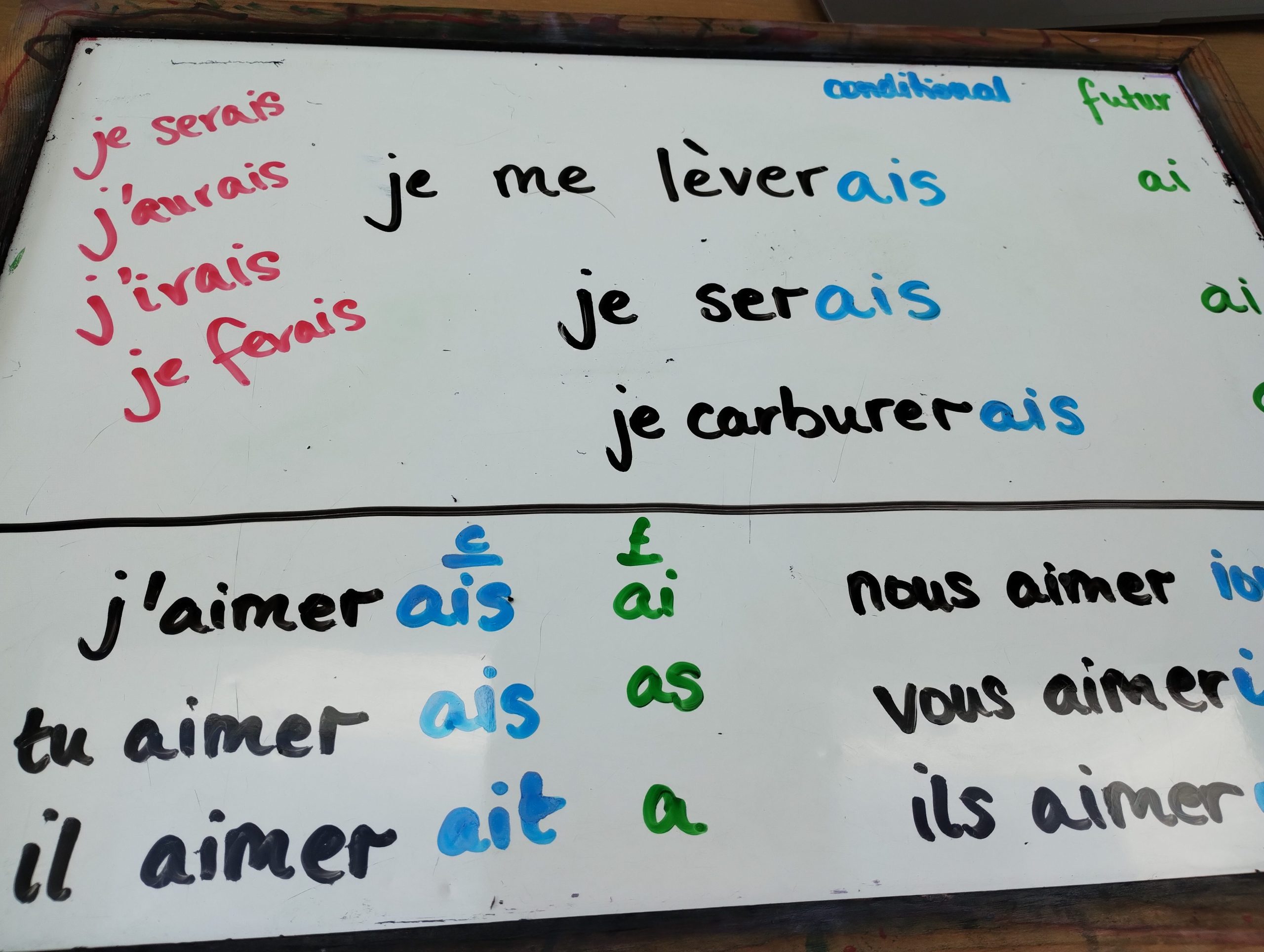
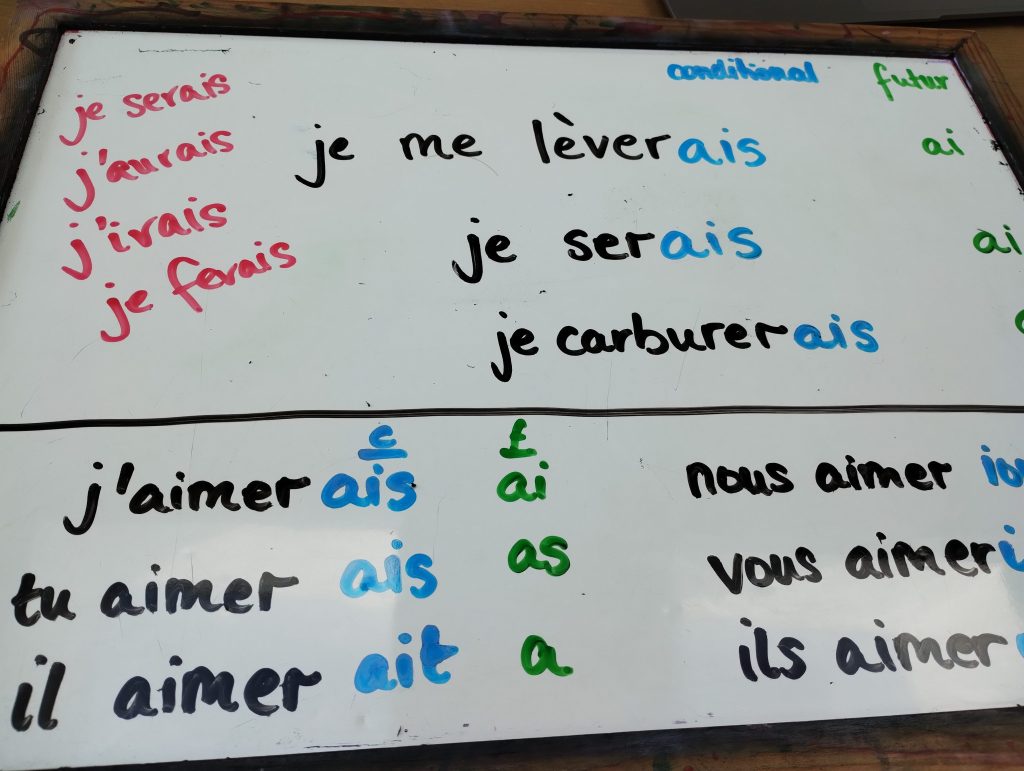
In Lessons 13-15 Alice introduces the conditional tense. This was a completely new idea for my child, and it would have been helpful before these lessons to go over the concept of the conditional, what it means, how it is similar to the future, and also to explore some common irregular verbs….serais, aurais, irais, ferais. One of my concerns about ‘comprehensible input’ is that I would really prefer more explicit instruction on new grammar as it arises.
Just one advisory point for children in this section. In Lesson 16, ‘Five things I like’, the first item is an aperitif, which didn’t bother me at all, it’s a culturally normal French concept. The last item was ‘j’aime me plaindre’, and that she likes to use ‘gros mots’, particularly ‘Merde’. I think it’s probably helpful to an extent to understand that all languages have swear words, so that you can avoid using them accidentally! If you wanted to skip this one, I couldn’t see that there were any new grammar topics introduced in this lesson.
Alice Ayel review: Stage 4
In the fourth ‘Adult’ stage, there is no longer a requirement for the learner to write. The emphasis is back on listening, but there is a big uptick in the speed and complexity of the French, and the introduction of new vocabulary without as much explanation. This stage is a history of France from Roman times up to Louis IX. I absolutely loved this stage, I knew very little about medieval France and found it fascinating! My child found it harder to keep up with the pace and complexity of the French, and did not always articulate when they were struggling. There were some videos which they particularly enjoyed (e.g. Asterix, castles, Guillaume le Conquerant) but in general this stage was harder for them.
There is a fifth ‘Senior’ stage, but we decided to leave Alice Ayel here, as I didn’t feel that my child was keeping pace with the new material, or was enjoying the lessons as much as they had been. It had ceased to be the most effective thing we could do with our time.
Advisory notes for children: In Stage 24 there is a brief mention of a possible incestuous affair between Eleanor of Aquitaine and her uncle, en route to the Crusade. The historical evidence for this is limited, and you may wish to pre-watch and possibly skip a couple of minutes.
Final thoughts, and what we used next.
Alice Ayel is a very gifted teacher of the French language, and a pleasure to watch and learn from. She has thoughtfully found ways to increase the complexity of the material very incrementally, both syntax and vocabulary. The first two stages of her course in particular are very suitable for children, and a good way to help them grow in confidence and exposure to longer stretches of spoken French.
Whilst I really enjoyed stages 3 and 4 myself, I am not sure that they were the best fit for my particular child, compared to other material we could have been using in that same teaching time. I do think that they would be a good fit for a very motivated child, or for most adults who are better able to self-evaluate, and invest time in looking up fresh vocabulary and rewatching difficult sections. For a child who already has reasonable spoken French skills, I would really recommend the ‘Adult stage’ videos as a wonderful introduction to French history.
At the time of writing, Alice Ayel is available at a reasonable price for a variety of subscription lengths, so it is very possible to take out a three-month subscription, use it for the first two stages, and then assess whether the third stage would be a good fit.
Following up from Alice Ayel, we are using a mixture of other resources:
- French Conversation with Paul Noble (interestingly we are moving through this material much more confidently than we were before Alice Ayel).
- Using a French tutor to get much more spoken French practice.
- An A1 French grammar workbook from Hachette, to fill in any grammar gaps at this level.