

Using Paul Noble’s French Courses with children
Paul Noble’s French courses are an excellent resources for picking up the basic grammar structures of the language. We have now used three of Paul’s French courses, and are working on the fourth course French Conversation with Paul Noble.
In this review, I explain how the courses work, and my experience of using them with a child. I will also share some additional tips for how we tried to get the most out of the courses.
- The general structure of the courses
- Paul Noble’s French for Kids
- Learn French with Paul Noble: Complete Course
- Next Steps in French with Paul Noble
The general structure of the courses
Paul Noble’s courses are all audiobooks, with an accompanying PDF booklet which is easily available online, and is useful for checking the general direction of the course. (The order of the written conversation in the booklet is not always the same as on the audiobook.) The courses include a lot of built-in revision so that you retain material learnt earlier in the course.
There is a real focus on learning basic grammatical structures, and deploying them in a variety of scenarios. This is very different from the French I learnt at primary school. Rather than learning stock phrases and colours, Paul Noble immediately gives you key words and structures that can be used in lots of different ways. The flip-side is that the courses use quite a limited pool of vocabulary, because they are so focussed on building up basic grammar.
This post contains affiliate links. As an Amazon Associate, I earn from qualifying purchases.
Paul Noble’s French for Kids
Course length: 8 hours 51 minutes

This was the first course that we used, as I had heard it recommended several times as an initial resource for teaching French to children. When we began, my child had a small amount of exposure to French colours, numbers and songs, but no meaningful French language.
The course begins with the passé composé (a completed past action), and uses a few simple structures (e.g. j’ai visité, j’ai preparé, j’ai decoré) which sound similar to the English meaning to build up the student’s experience and confidence. All these verb structures are dependent on avoir (to have) as the auxiliary verb, so that once the student has learned to conjugate avoir (j’ai, tu as, il a, nous avons, vous avez, ils ont) they are able to express a surprisingly great variety of ideas.
The accompanying booklet (here) shows the full contents of the course. I was really happy that by the end of the course, my child could confidently conjugate some core verbs in the present tense:
- aller (to go)
- avoir (to have)
- être (to be)
- pouvoir (to be able to)
- vouloir (to want)
My child was also able to ask questions in a variety of forms, use the futur proche (aller+infinitive) to talk about future plans, and had some useful core vocabulary to enrich their conversation like parce que (because) and mais (but). Perhaps more importantly, my child believed that they could learn and speak French, and was no longer intimidated by the language learning process.
We began this course when my child was roughly 7 years old, and it was their first real experience of learning a foreign language. The ‘chapters’ on this course are pretty short, typically around 6 to 8 minutes, though with pauses they take longer. I found that we needed quite a lot of review at this point (this decreased over time), so each week we would listen to the last week’s chapter for review, and one new chapter. This typically took about 20 minutes per week.
I wasn’t sure how much to major on pronunciation. Starting to speak a foreign language was already a daunting experience, and I didn’t want to be correcting pronunciation all the time, so it was a bit of a tricky balance to get right. With hindsight, I wish I had put a bit more effort into working on a French ‘R’ sound at this point, so that bad habits didn’t get entrenched.
Learn French with Paul Noble: Complete Course
Course length: 12 hours 36 minutes
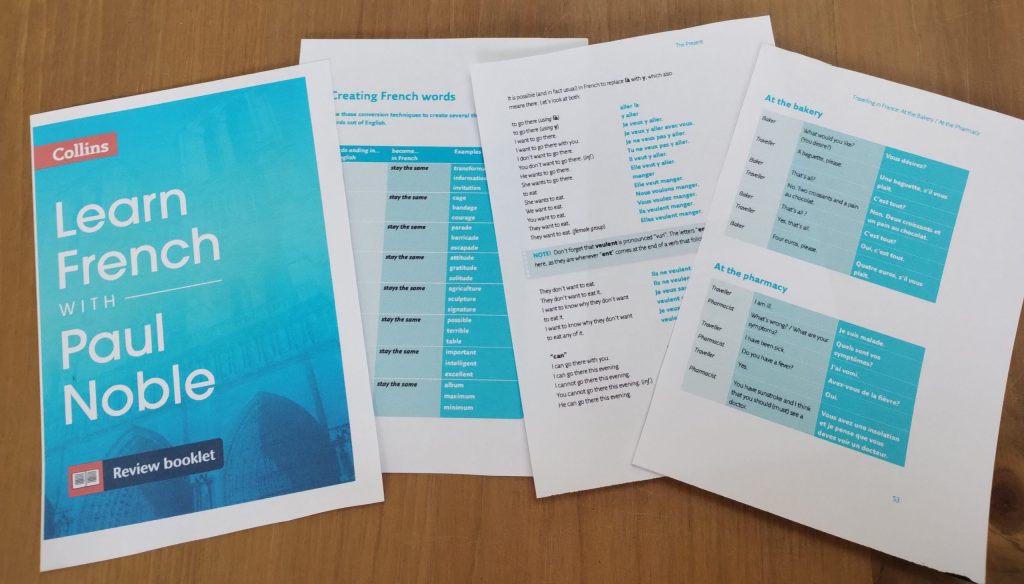
Having reached the end of Paul Noble’s children’s course (which took us quite a while!) I wasn’t sure where to dive in to his series of French resources for adults. I decided to try starting at the beginning, which worked out really well. There was a reasonable amount of overlap between the kids’ course and the first chapters of the adults’ course, but there was still new vocabulary to learn, and it meant that my child started the adult course really confidently and quickly, without needing to repeat any sections.
This first adult course is faster paced than the children’s course. The spoken French is only said once (rather than twice in the children’s course), and it seemed to me that new concepts were introduced faster. The ‘chapters’ are also much longer, typically 20 minutes rather than 6-8 minutes in the kids’ course. However, I found that we needed much less repetition, and moved to only repeating those chapters where my child was struggling, or there were lots of new concepts. We usually managed to do half a chapter (or roughly 1o minutes) each session, which with pauses and discussion took us 15-20 minutes.
I was concerned that there might be some unsuitable material for children in the adult course, but this was not the case at all. Learning how to order a bottle of white wine was as far as it went! There was some vocabulary which is less immediately relevant to children (e.g. how to book a hotel room), but the underlying concepts were still useful.
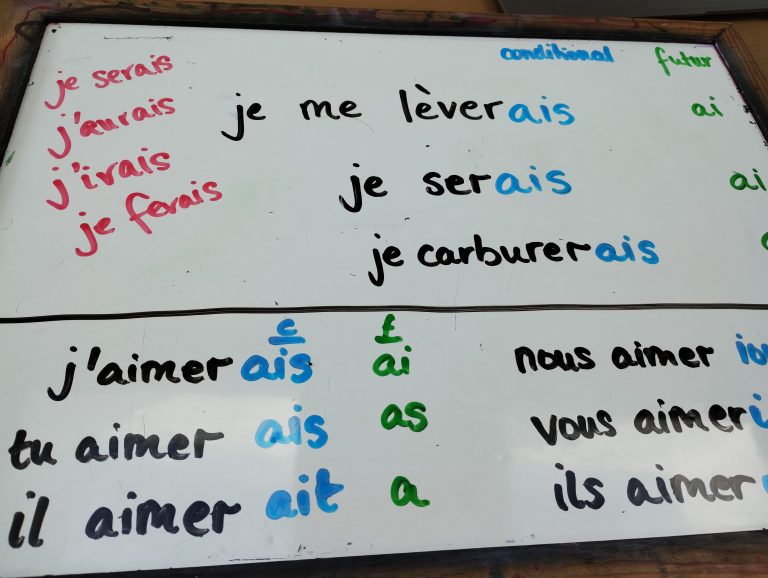
One change we made for this course was that I started for the first time to write out key verb conjugations and vocabulary. I did this so that my child could begin to see written French, and understand how the grammar fits together. I had not done this initially, as I read that children can be tempted to read the French words with English phonology, and develop poor pronunciation. However, I felt that by this point, we had a solid baseline of French language to work from, and usually I was recording words that they were already using, but just helping them to organise them in a grammatically logical way. For the more difficult topics (e.g. pronouns), I did also allowed them to refer to these notes as we went along.
The Complete Course provides an extraordinary amount of grammar instruction in only twelve hours. You can view the course booklet here to see all the material. Having already done Paul Noble’s kids’ course, the key new concepts that stood out to me were:
- Passé composé with être (what I learnt at school as Mr Vans Tramped)
- Futur simple (e.g. je mangerai)
- The verb devoir (to have to)
- More extensive experience with putting things into the negative
- Correct placement of the pronoun ‘y’ in a sentence.
- Asking directions and prepositions
- Using ‘on’ for ‘we’.
- Extensive exercises on using and ordering pronouns
Our experience was that some of the final sections of the Complete Course were oddly advanced, particularly the section on pronouns, and much harder than anything we encountered in the subsequent Next Steps intermediate course. I drew up some pronoun tables and allowed my child to use those extensively for this section, as I was pretty comfortable with them not mastering all the concepts at this point in their language learning.
Next Steps in French with Paul Noble
Course length: 7 hours 58 minutes

The Next Steps course actually felt refreshingly easy, coming off the back of the tricky final sections of the Complete Course. As with the kids course, the spoken French sections are repeated twice, which makes everything feel a bit less frenetic! There is more time to regroup. I also felt that there was a lower proportion of core new grammar in this course, with more of a focus on common structures which can help you to expand the range of things you can say.
By this point we had upped the frequency of French sessions to roughly 20 minutes, three times per week, so that we were able to get through this course more quickly. I continued to write out key vocabulary and grammar concepts so that my child could have some more exposure to written French, and have a reference point for understanding the grammar logically.
You can view the accompanying booklet for the Next Steps course here. The core new concepts were:
- Structures with avoir (j’ai besoin de, j’ai peur de, j’ai envie de, j’ai horreur de)
- Structures with être (je suis en train de, je suis sur le point de)
- À cause de/Grâce à
- The imperfect past tense, including conjugating avoir and être
- Extensive practice on when to use the passé composé and when to use the imparfait.
We really enjoyed this course, and I felt that my child now had a solid foundation of grammar, and was ready to begin expanding their vocabulary and exposure to more rapid spoken French, and possibly beginning to move towards more reading and writing.
French Conversation with Paul Noble
Course length: 11 hours 55 minutes

I was delighted to find that Paul Noble has released a new follow-on course to his Next Steps in French. This new conversation course is in some ways structured quite differently from the previous courses. It is built around a series of short French dialogues, scenes from everyday life, though sometimes rather comedic! The course does contain plenty of new vocabulary and some new structures and grammar, but this is introduced naturally as it occurs in the dialogues.
The French spoken in the dialogues is very rapid, and sometimes informal, so it provides excellent practice at ‘honing your ear’ to be ready to listen to native French speakers. After each dialogue, there is around 20-30 minutes of discussion and practice, based around that dialogue. You then listen to the dialogue again, with the hope being that you understand substantially more of the conversation. We have certainly found this to be true!
I was initially a little sceptical about the new format, having really enjoyed Paul Noble’s previous courses. However, since beginning the course (we have completed about a quarter so far), I feel very positive about it. Grammar isn’t everything, and I can see that my child’s confidence is really increasing as they are able to understand more rapidly spoken French. From reading the course booklet, I think that we will come onto some discussion of the subjunctive later in the course, so new grammar does still continue to be incorporated.
We have begun using some other French resources which do not have much of a speaking component, and I really appreciate being able to keep this French Conversation course going roughly once a week, to make sure that my child is still getting some practice at generating spoken French.
You can view the course booklet for French Conversation here to get a sense of how it is structured. We typically listen to the dialogue in French and English, and then tackle one of the discussion ‘chapters’ each section. There are usually two or three chapters for each dialogue. This does mean moving backwards and forwards through the audiobook a little (e.g. for chapter 2 of a dialogue, we go back to listen to the dialogue, then forward again to find the right discussion section). However, I haven’t found this to be too much of an issue as long as we stick to the chapter breaks. This gives us about a 20 minute lesson time.
Final Thoughts
Paul Noble’s French courses have been an excellent fit for my family for beginners’ French. Starting with oral language skills, and a strong foundation of grammar, has given us a really confident base from which to move forward into more vocabulary acquisition and increased fluency. Paul’s clear explanations and spaced review activities have helped my child to retain nearly all the French material they have covered, so I feel like the courses have been a very efficient and productive use of learning time.
One other thing that I really appreciate about the courses is that I can usually multitask, and do a practical chore like folding the laundry at the same time as supervising French practice! This advantage is not to be underestimated in busy family life.
You may also be interested in my review of Alice Ayel’s comprehensible input French course.
Thank you for this helpful and thorough review. My 10 year old and I have started the PN for kids course, but I’m glad to find this review from someone who has done all the courses all the way with a child.
Please share some of the other French Resources you are using and where you will go (or did go) with French after completing the PN: Conversational French Course.
Thanks for your comment Miss A! We have moved on to Alice Ayel’s online French course. We are only about half way through but I will write a proper review when we are done. It is ‘Comprehensible Input’, which is a very different approach to Paul Noble. The grammar level so far is lower than Paul Noble, but my child is getting lots of exposure to extended spoken French stories, and lots and lots of rich vocabulary. The stories are good fun for children. In the third level, Alice gently introduces written French. I liked Alice Ayel’s course because I felt it would cover several areas of French where we needed to progress, namely listening skills, vocabulary, and transitioning to writing French. I am happy with the course so far. We continue to use Paul Noble’s Conversational French about once a week for some spoken output.