

First chapter books for children
This is the last in a series of articles is for parents who are considering teaching their child to read themselves. I think it is one of the most rewarding things you can do as a parent. Definitely worth having a go! In this final post, I recommend some series of early chapter books for children who can now read fairly fluently, and are ready to begin the transition to longer books with fewer pictures.
Articles in the series:
- Phonological awareness
- Phonics stages overview for parents
- Choosing decodable phonics readers
- What next? Early chapter books (this article)
These book recommendations are roughly ordered by increasing level of difficulty. The first books mentioned below use quite straightforward language and syntax, and still have pictures on almost every page, whilst the books towards the bottom of the list have more text, richer vocabulary, and fewer pictures.
- Polly and the Puffin
- The Gaskitt Family
- Usborne Young Reading
- Anna Hibiscus
- Animal Tales
- Olga da Polga
- The Railway Cat
- Early chapter book series we haven’t enjoyed so much
This post contains affiliate links. As an Amazon Associate, I earn from qualifying purchases.
Polly and the Puffin
Jenny Colgan

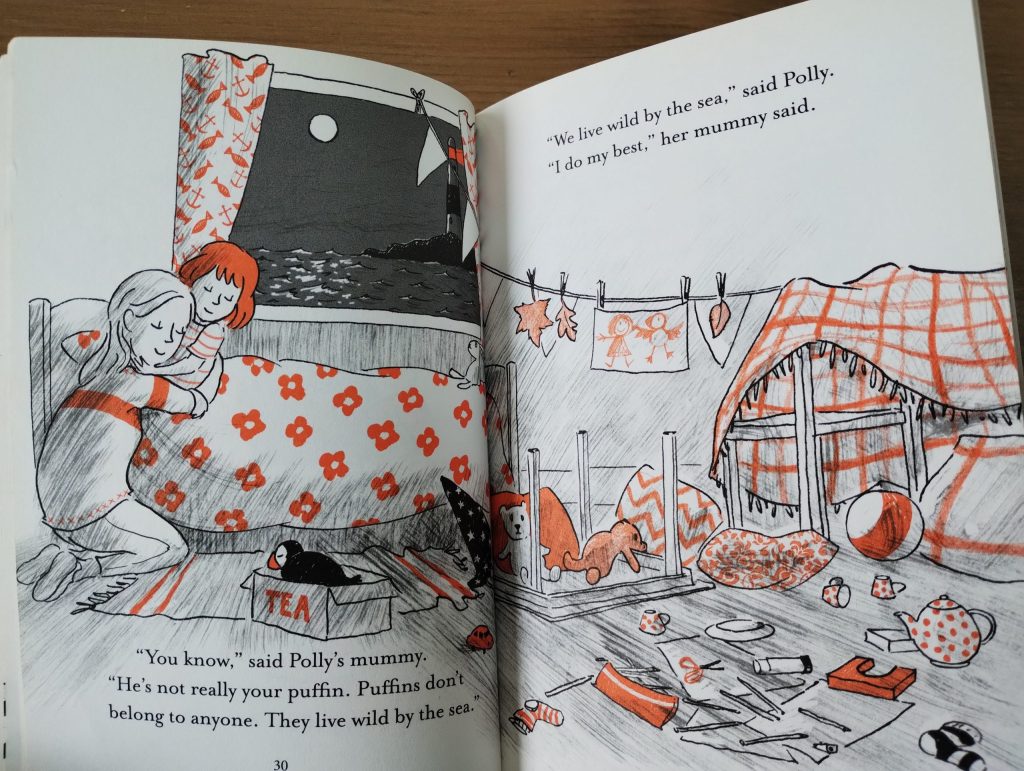
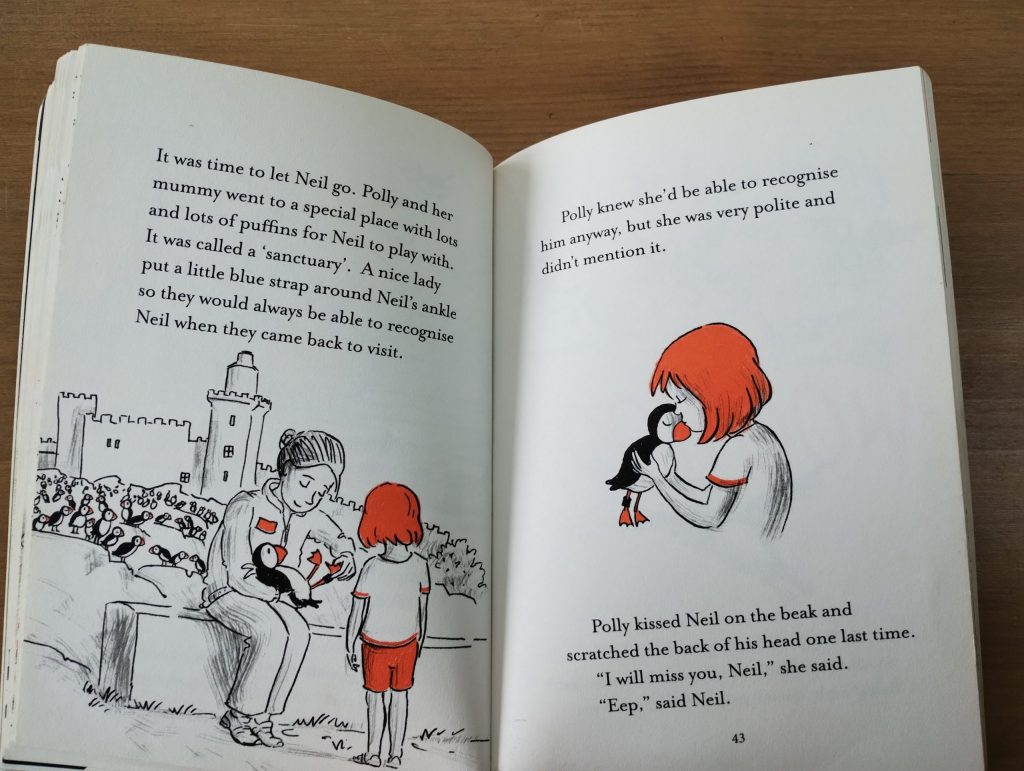
The Polly and the Puffin stories are not actually chapter books, but they are long enough that we tend to read them in two or three sittings. There are pictures on every page, and the vocabulary is not too complex, so I think these are a lovely fiction option for children beginning to transition away from reading scheme books.
Polly lives in a cottage by the sea, and in the first book a young puffin accidentally crash lands in her house. Polly and her mother nurse Neil (the puffin) back to health, and he becomes a firm friend. Polly is about five years old, and she experiences similar challenges and frustrations to the average five year old. She gets upset that Neil needs to go back to the wild when his wing has healed, gets nervous about her father (a fisherman) being at sea during a storm, and struggles with making friends when she starts school. I find her a likeable character, and enjoyed her interactions with her mother, who tries to help her through these challenges.
The Gaskitt Family series
Allan Ahlberg

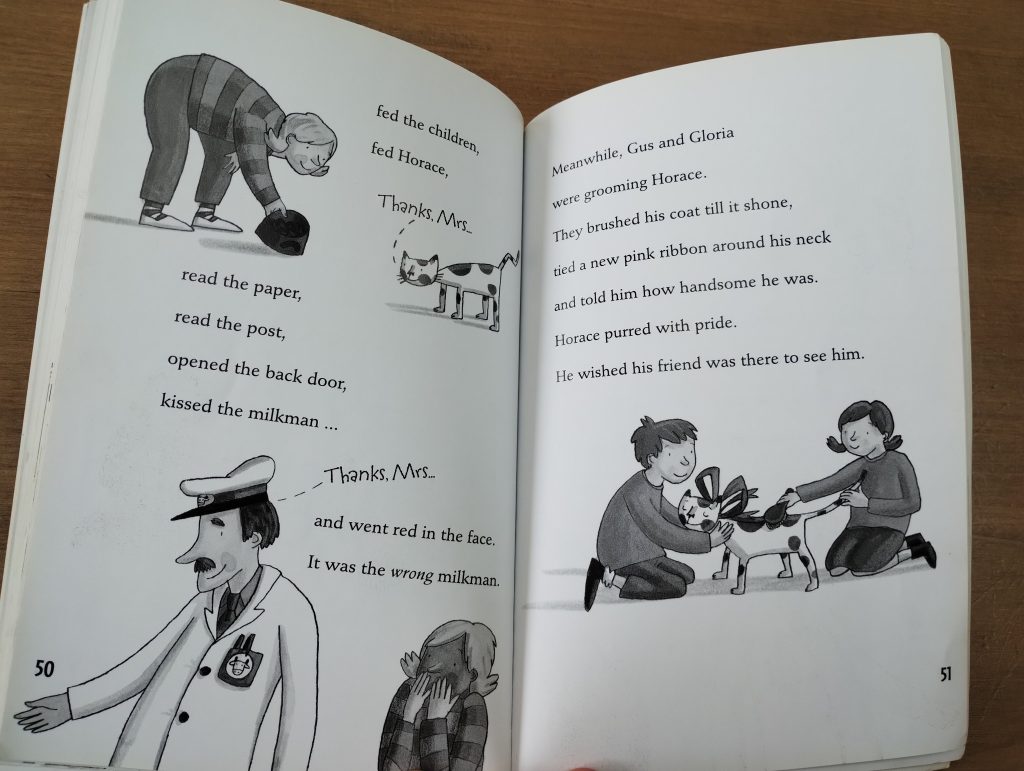
There are four books in this series about the Gaskitt family. They are technically chapter books, but the chapters are very short, and the books are extensively illustrated on every page, so they are a good first choice for children moving on from reading schemes. The vocabulary is generally straightforward, but with a few interesting and more complex words in each book. The style is informal and fun, with diagrams and annotations.
These are certainly on the ‘less serious’ end of the recommendations in this list, but the plotlines and inference can actually be quite complex. The books all involve at least one mystery of some sort. All of my children have needed some help to follow what is going on and answer the ‘can you guess?’ questions in the books. For example, in one story, Mrs Gaskitt, normally a very active character, spends most of the book in bed eating odd food combinations, and looking at baby photo albums, but she isn’t ill. I don’t think any of my children managed to understand that she was heavily pregnant until it was spelled out to them! There was one sub-plot in The Woman who Won Things that I didn’t love, where Mrs Gaskitt kisses the postman/milkman every morning, because it is Mr Gaskitt’s current job, but one day it isn’t Mr Gaskitt and she kisses the wrong man and gets very embarassed.


I like the short chapters, which make it easy to break these stories up over a few reading sessions. The books in the series are:
- The Man who Wore all his Clothes
- The Woman who Won Things
- The Cat who Got Carried Away
- The Children who Smelled a Rat
Usborne Young Reading 2 and Young Reading 3

This is really my favourite series of transitional books for children who have graduated from reading schemes. There are plenty of books to choose from. I generally prefer the non-fiction options in this series, but there are some good fiction options as well. The books are chapter books that we tend to read in two or three sittings. There are high quality colour illustrations on every page, though these reduce slightly as you move up the series.
You can purchase some large box sets of Usborne Young Reading books at very reasonable prices. The Usborne Reading Collection contains 40 books from YR1 and YR2, mostly simplified versions of classic stories, but with some non-fiction and collections of shorter stories on themes. The Usborne Reading Collection for Confident Readers is similar, but contains YR2 and YR3 stories at a higher complexity level. I have not purchased these box sets, because I tend to prefer the non-fiction books, and these are more easily purchased individually. Also, the box sets are paperback, whereas the individual books are hardback and often have bookmark ribbons. Many of the books are quite readily available second hand.
I have mixed feelings about the adapted classics. They can be well done, and a good introduction before moving on to the real book or play. For example, I think reading an adapted version of a Shakespeare play can be really helpful before a child sees the play at the theatre. However, for some stories like A Secret Garden or The Railway Children, I feel that most children who are reading well enough for the adapted version could easily cope with the original on audiobook, and get far more from the experience. In order to shorten these books to 50 or 60 pages, one has to lose so much of the plotline. We have quite a few of the Usborne YR Greek myth adaptations, and I find them a whistlestop tour of difficult names and lots of action, in order to fit everything in! Having said all that, I have one child who loves the Greek myth adaptations, and another who often reread the Treasure Island and Robin Hood adaptations, so they don’t share my qualms!


I particularly like the short biographies in the YR3 series. There are some interesting characters included, and I generally find them to be very informative. In YR2, ‘The Story of…’ books have been popular in our house for a brief history of different themes, like a simplified Ladybird book. There are often some very helpful diagrams included; for example The Great Fire of London has a really interesting map of the daily spread of the fire on the inside cover.
If you want to gauge the relative difficulty of the books you are considering, this document on book bands and this document on lexile levels are quite helpful, as there is a big spread across the books.
Anna Hibiscus
Atinuke

I really like these stories, and have grown to like them more as we have gone through the series. ‘Anna Hibiscus lives in Africa, amazing Africa’. She lives in a big white house with her extended family. Each book in this series has four chapters with stories from Anna Hibiscus’ life. There is at least one picture on each double-page spread, and generally only a few trickier words in each book. I have found this series to be particularly good for one of my children who needs to work harder at comprehension. They quickly became familiar with the key characters and setting, so that they were able to concentrate more on the events in each chapter. There were a few harder stories to understand (e.g. the family buys a generator to provide electricity during blackouts) but this is really only a handful of chapters. We have really enjoyed learning about a different culture through Anna’s traditional extended African family.
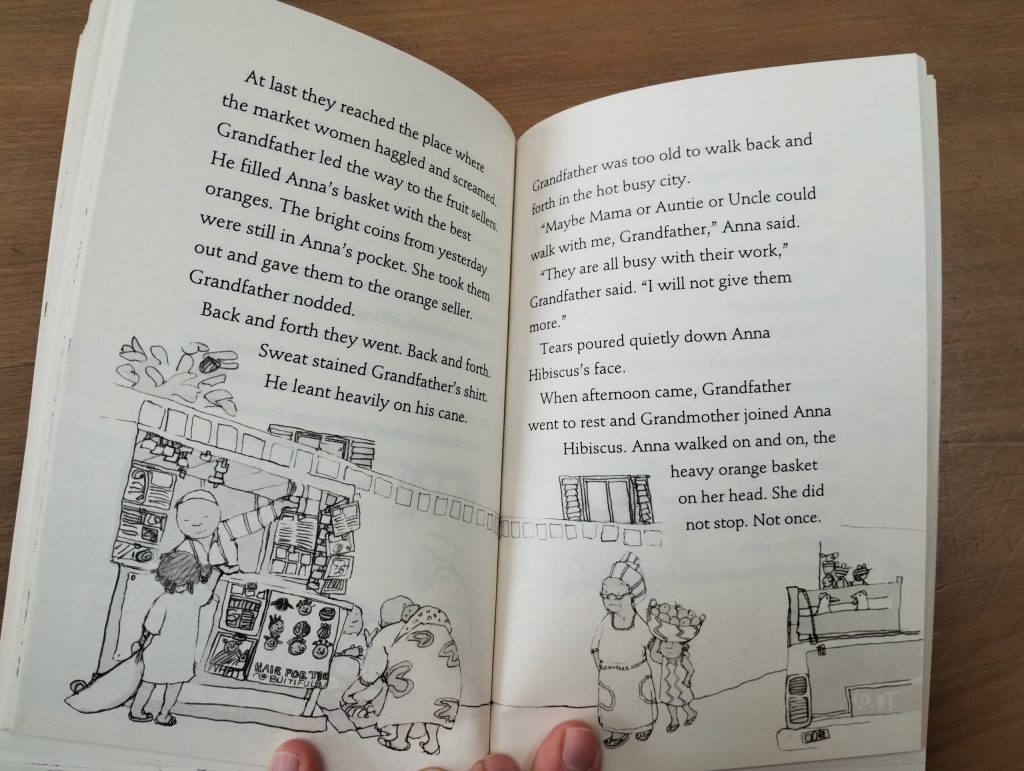


Generally, the family have pretty high expectations for the children’s behaviour, and where Anna gets things wrong (normally because she hasn’t thought through the implications of her actions for other people), she helps to make things right. The chapters in these books are on the longer side, and we generally split most chapters in half and read them over two days.
Atinuke also has a series of beginner chapter books called The Number 1 Car Spotter which we haven’t tried yet.
Animal Tales – The Owl who was Afraid of the Dark
Jill Tomlinson
This is a classic series of early chapter books from Jill Tomlinson. Each book features a young animal learning about the world, and the characters are very loveable. The books are illustrated, but roughly every other double page spread, and often small illustrations rather than bigger ones which develop the plot, so I think this is a slightly harder early chapter book for children who are growing in confidence.


The books in the series are:
- The Owl who was Afraid of the Dark
- The Otter who Wanted to Know
- The Penguin who Wanted to Find Out
- The Aardvark who Wasn’t Sure
- The Hen who Wouldn’t Give Up
- The Cat who Wanted to Go Home
- The Gorilla who Wanted to Grow Up
Olga da Polga
Michael Bond
A series of books by the author of Paddington Bear about a guinea pig called Olga and her adventures living with a family of humans. The chapters are short and humorous, and there are black-and-white illustrations every couple of pages. I would say that these are at a similar level to the Jill Tomlinson Animal Tales.


The Railway Cat
Phyllis Arkle
A series of books about a cat called Alfie who lives at a British railways station. He has all sorts of adventures and often gets confused about the motivations of humans. There are some black-and-white illustrations, but only every few pages. The chapters are short, and the text is quite large, but there is some more complex vocabulary (e.g. occupants, exasperated, bristled, marooned). I would say that these books would suit a child who is moving towards managing normal children’s chapter books.


Some other early chapter books we haven’t enjoyed as much
These are books I quite often see recommended for this early chapter book stage, but which we haven’t enjoyed as much. Sometimes this is because the language and style is more US-centric. For some other books, I didn’t appreciated the content and humour. I still think it is helpful to comment on these books rather than to be unerringly positive.
Claude
These books are not-quite chapter books, though they are long enough to need reading over a couple of sittings. They are currently very popular in the UK, and follow the adventures of a small dog, Claude, and his friend Sir Bobblysock, a stripy sock. The books are illustrated in cartoon style in three colours. We have read a couple of these books, and I didn’t really appreciate the toilet humour (e.g. a doctor called Dr Achinbum, where I had to help my children sound out the name, and then explain the humour). The second book we read, Claude: Lights, Camera, Action! was downright inappropriate in my view. A big busted character called Miss Melons, a baker called Mr Lovelybuns, lots of illustrations of cleavage. I don’t think that is necessary or appropriate in a book for small children.
My Father’s Dragon
This is often recommended on US-based lists of early chapter books, and we just haven’t been able to get into it. The plotline was pretty boring, there was no character development, and broadly the same thing happens in each chapter.
Zoey and Sassafras
This is a series of fictional books with a science-theme. We tried out the first book, Zoey and Sassafras: Dragons and Marshmallows. There are black and white cartoon style illustrations on most pages, and the text is large and simple. We struggled with the colloquial American language, with lots of words like gotten and yikes, and very short sentences with exclamation marks. I didn’t feel that the content was high enough quality to redeem it.


