How I teach my children to read: Phonological Awareness
This is part of a series of articles for parents who are considering teaching their child to read themselves. I think it is one of the most rewarding things you can do as a parent. Definitely worth having a go! Having taught several of my children to read, here is my favourite step-by-step method. The headline is: prioritise phonological awareness first, introduce phonics in a logical order, and use lots of fun decodable readers. In this first post, we’re going to be talking about phonological awareness.
I had never heard of phonological awareness when I was teaching my first child to read, but you have probably already helped your child to build these skills! If you have played ‘I spy with my little eye’ or made up silly rhyming words, then you have been helping your child to develop phonological awareness. I now think this is a really important pre-reading skill, that you can work on without going near written letters.
Articles in this series:
- Phonological awareness (this article)
- Phonics stages overview for parents
- Choosing decodable phonics readers
- What next? Early chapter books
What is phonological awareness?
Phonological awareness is about hearing and recognising the different sounds that make up a language, and learning to manipulate them. Having good phonological awareness is a strong predictor of later reading skills.
Phonological awareness covers skills like:
- Being able to tell what sound is at the beginning or end of a word
- Identifying rhyming words
- Knowing how many syllables are in a word
- Breaking down a word into syllables, or going further, into individual sounds.
- Being able to remove or add a sound to a word (e.g. take the ‘s’ off steam to make team, add a ‘t’ sound to go to make goat).
The great news is that you can help your child to develop phonological awareness in easy and fun ways, by playing games together.
Games for identifying the first and last sound in a word
One of my favourite games is Find the Animal. For this game, you need some toy animals or cards with pictures of different animals. Ask your child to find the ‘animal that begins with a ‘p’ sound’. Once they are confident with this activity, you can start trying to find the animal which ends with a certain sound (e.g. dog ends with a ‘g’). This is a harder challenge.

I Spy is also a great game for really honing in on the first sound in words.
Activities for working on rhymes
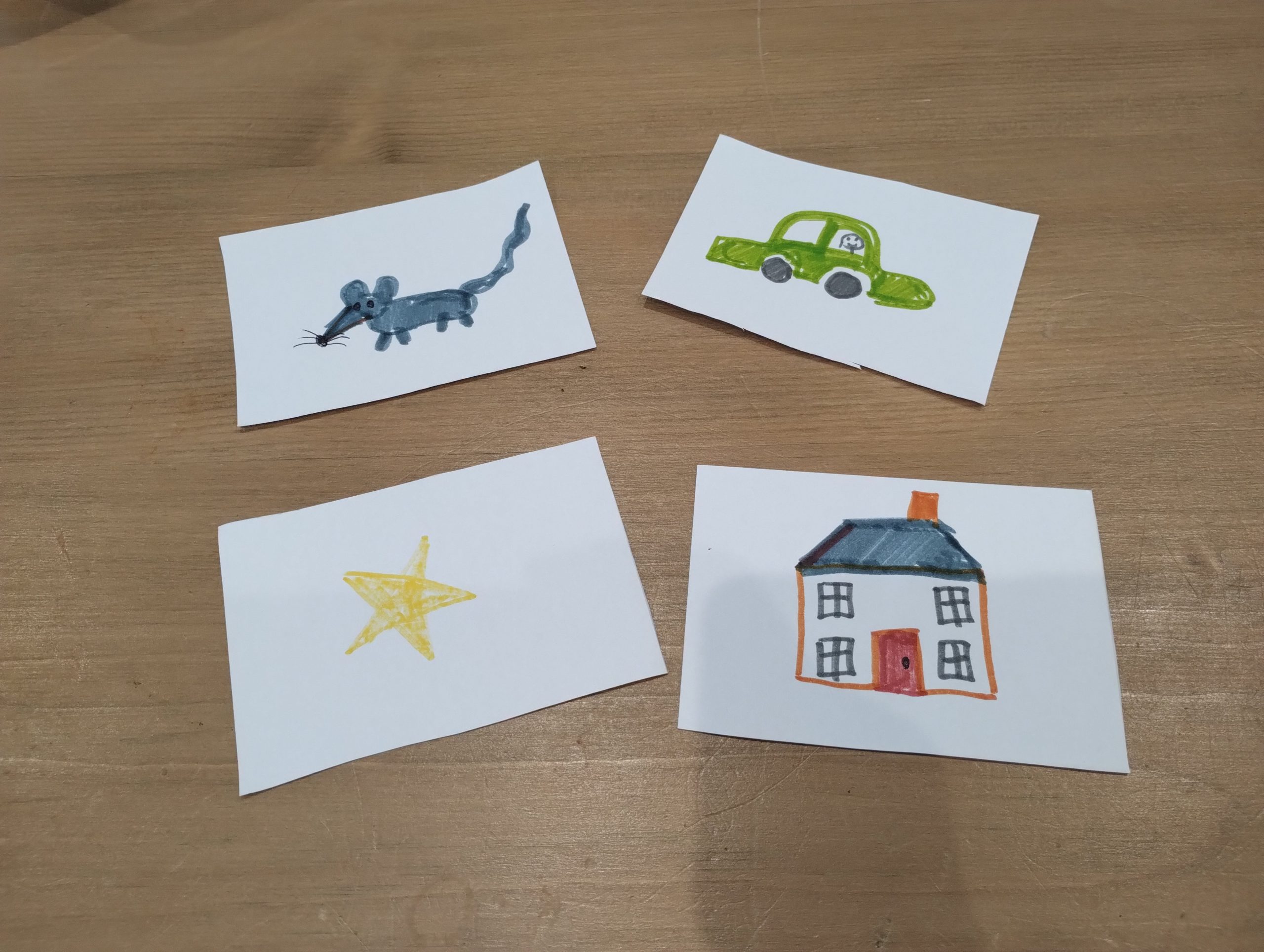
A good rhyming activity is to make a dozen or so small cards with little pictures on, with pairs of cards which rhyme. For example, star and car, mouse and house, cat and hat. As a starter activity, you could put three cards out, two of which rhyme and one of which does not. The challenge is to find the rhyming words, and the odd one out. Once your child has built confidence with this activity, you can put out more cards and have a game of finding the matching pairs. A greater challenge is a memory game where the cards are face down.

I also found it helpful to read lots of rhyming bedtime stories (Julia Donaldson books are great!), and to play silly rhyming games whilst out and about, trying to think of words that rhyme. Made-up words are completely fine, the point of the game is to get an ear for the rhyming sounds.
Blending games
These games are designed to help children understand how to break words down into individual sounds, and to put them back together again. At first, model breaking the words down, and have your child put them back together again. The toy animals can come out again! Ask your child to find you the p-i-g or the d-o-g. It is really important to just use the sounds that are heard in the word, not the letter names. We are interested in discerning sounds rather than letters.

Once your child is growing in confidence with blending short words back together, you can start to introduce words with slightly more sounds. Perhaps ask for the j-i-r-ah-f or the k-a-ng-a-r-oo.
The next step is to let your child be the teacher, and split the words into sounds, and challenge you to find the right toy. Often, children will successfully manage to split down some of the sounds but not all of them. Praise their success, and model completely breaking down the word.
Next steps
As my children build confidence in manipulating the sounds in words, I start to introduce the written letters, a few at a time. I prefer to use tactile manipulative letters at this stage that children can feel and hold. Some of the games above can be adapted to include letters. For example, finding the animal that begins with this sound (holding up a letter), or putting out three different letters, and asking your child to choose which one the animal begins with.
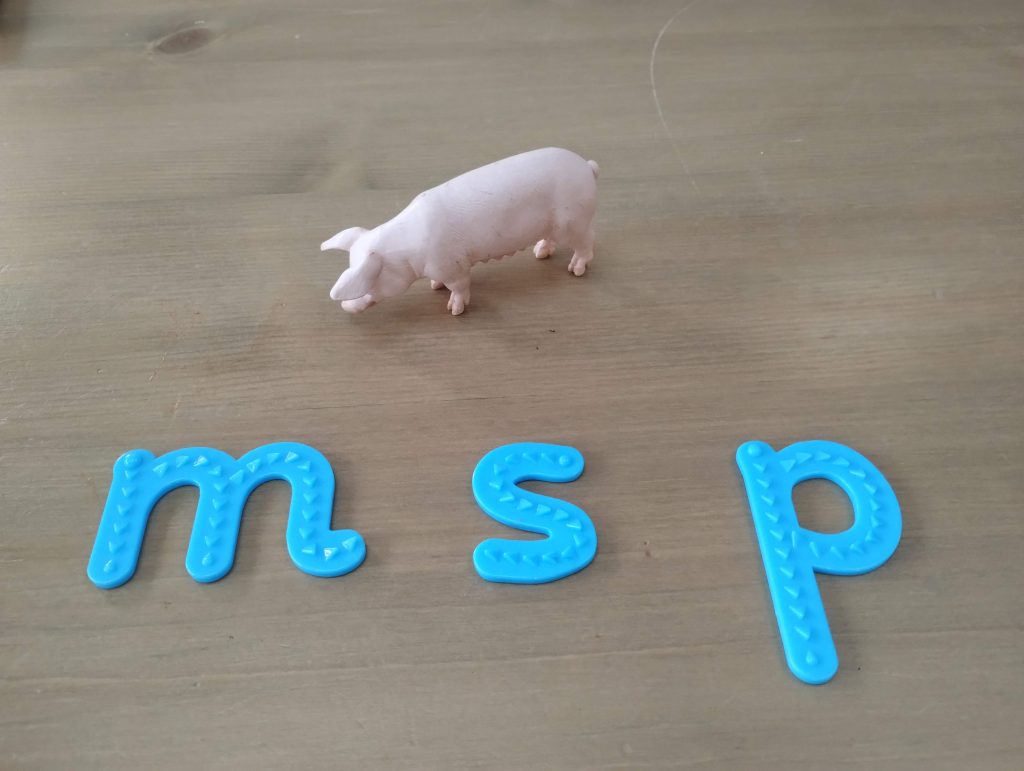
Some children may enjoy building an alphabet scrapbook. Label each page in a scrapbook with a different letter sound, and have some fun cut pictures out of magazines and junk mail. Work out together where to stick the pictures in the scrapbook, based on the sound they begin with. For a word like giraffe, I would just say “the letter G can say ‘g’ or ‘j'” as we stick it on the G page.

Having built up confidence with these pre-reading skills, you are now ready to begin working on your child’s first words! Have a look at the second article in this series, a phonics overview, to get a sense of the overall picture of phonics, before diving into decodable readers.