

Logic resources for children
I absolutely love logic! In this article, I share some of my favourite resources for exploring logic with children. There are games, puzzle books, stories, and other activities, for a variety of ages.
This post contains affiliate links. As an Amazon Associate, I earn from qualifying purchases.
Single player games and activities
These ideas are hands-on physical puzzles and other games primarily designed to be used by one child at a time. They tend to be on the more expensive end of logic resources, both for price and for space. I am therefore quite picky about which ones get to stay in our house! These are my favourites for a range of ages.
Turing Tumble
Upper Story
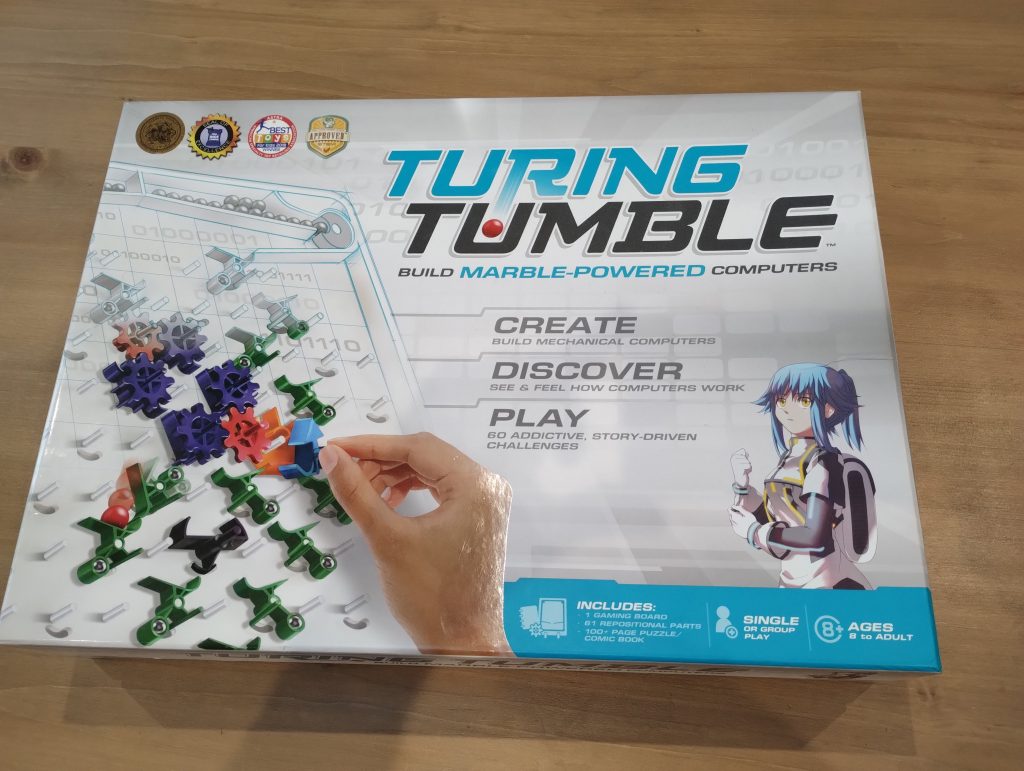
The Turing Tumble is an ingenious and very versatile toy for teaching children about computing, without any screen time. It is essentially a very adaptable marble-run, which teaches children about logic-gates. Of the activities in this section, this is the one that comes closest to teaching children ‘formal’ logic skills, specifically logic-gates.
There is an accompanying manual with lots of challenges. The first few challenges are very straightforward, but they become progressively more challenging until the last few are actually pretty difficult for adults. There is an accompanying cartoon story line which didn’t particularly grab us, but the Turing Tumble itself has been really popular here.
It is the sort of toy that a child will play with, reach the limit of their understanding, and then come back to a year later and take it a bit further.
One word of warning: the balls for the game are very small. If you have babies or toddlers in the house, this is one to keep in a separate room from them.
Rush Hour
ThinkFun
A tactile logic challenge that has surprised me in its popularity and longevity. The board is covered in small plastic cars that can only move backwards and forwards along runners. In the base of the game there is a deck of cards with challenges of increasing difficulty. In each challenge, the goal is to ‘unblock’ the traffic jam, and release the red car from the board’s exit.
My family find this quite a calming game, something to sit and puzzle out by yourself for a few minutes of downtime. It’s very portable (The whole thing comes in a mesh bag) so it’s a good one to take on holiday.

Camelot Jr.
Smart Games
One for younger children. The game is made up of some sturdy wooden blocks attractively painted in different colours. The goal is to get the knight figurine to the princess without him falling, or reaching a tower he can’t climb. Children have to experiment with different arrangements of the blocks.
The activity comes with a little spiral-bound guide to all the different challenges, which become progressively more difficult. This is a good game for teaching tenacity, and encouraging children to try different approaches until they find something that works.
We have had a couple of Smart Games activities for preschoolers (e.g. Three Little Piggies), and this is the one that has had the most longevity and popularity. I think the theme and the quality of the wooden pieces seemed to particularly resonate with my children.

Logic activity books
This category covers puzzle books where you are actively encouraged to answer questions and puzzles in the book, or occasionally to do so on separate working paper.
Beast Academy Grade 1
Art of Problem Solving
This is actually a maths curriculum! However, it has the best range and depth of logic puzzling for younger children that I have come across. For Grade 1, the cartoons and activities are all included in the same book for simplicity. The workbook sections are attractively coloured and designed.
Logic is woven into many of the activities in the books, but the chapters that were particularly logic-focussed were:
- 1B Categories: Comparing several shapes and explaining which is the odd one out and why. Creating Venn diagrams.
- 1C Patterns: Choosing what comes next in a pattern. Triangle numbers, specifically helping children to understand the ‘handshake problem’.
- 1D Problem Solving: Following and writing simple ‘programs’ to direct a robot. Choosing an order for pieces to move in order to achieve a goal.
Beast Academy is quite expensive, but it is brilliantly thought out. I particularly loved the ideas and graphics used for explaining uses of triangle numbers, such as little monsters with different combinations of teeth coloured in. I would never have thought of it, but I love it!
Beast Academy also has puzzle books for Grades 2, 3 and 4. These are not very expensive, and contain lots of examples of the most ‘puzzle-y’ types of questions in the main curriculum. There are strategy tips, and each type of puzzle is arranged in order of increasing difficulty.

Usborne Superpuzzles series
I really enjoyed this series as a child. There are three books: Map & Maze Puzzles, Codes and Ciphers and Logic Puzzles. Obviously the third book, Logic Puzzles, is a great choice for teaching your child logic, but all three books will give lots of practice at deductive skills. You cannot write in the books, so your child will need some paper or an exercise book. I let mine put a pencil note of ones completed in the corners of the pages.
I really appreciate the range of logic puzzle styles in this book. There are plenty of the classic ‘grid’ puzzle, but also trial and error, truthtellers and liars, chess-type games, maps and many others.


There are clues at the back for each puzzle if you are struggling, so that you don’t need to resort to reading the answers.
I absolutely loved the Usborne Superpuzzles Logic book as a child but these are HARD puzzles, and a child may need to make several attempts to crack them. For some puzzles, especially the map puzzles, is extremely helpful to have a photocopy of the page so that you can scribble directly onto the pictures.

Mind Benders Logic Puzzles
There are several of these books ranging in difficulty from a book for 5 and 6 year olds, right up to teenagers. The books that we have used have all had the same format, being exclusively ‘grid’ logic puzzles. I have always bought PDF versions, which is cheaper from the UK, and limits frustration if a child makes a mistake. I can just print the puzzle again.
These books provide plenty of practice at ‘grid’ logic puzzles, but my child did experience some frustration around needing to know certain background information (sometimes culture specific) in order to solve the problems.
For example, can a baseball shortstop get four hits in a game? Out of baritone, clarinet, flute, oboe and trumpet, which are brass instruments, and which are reed instruments? Is a cardinal more colourful than a robin? Is it larger than a wren?
I generally go through the puzzles before giving them to my child and jot down notes to help with any issues like this. Occasionally we have had to pass a puzzle because it the information was so US-culture specific, but that’s perhaps one or two puzzles per book.
Overall, a good resource but limited to this one theme of grid-puzzles. I prefer the theming of Usborne Logic Superpuzzles, but a big plus point of Mind Benders is that the puzzle grid is already nicely drawn out for you.

Logic reading books
This category is for books that teach about logic and logical ideas, but are more for reading than doing activities.
Anno’s Hat Tricks
This is a wonderful book. The premise is that there are several children (including the reader, ‘Shadowchild’) who are wearing different coloured hats. The book guides the child through various scenarios in which they have to work out what coloured hats the different children are wearing, using limited information.


Do you have any favourite logic resources for children? Let me know in the comments below!
