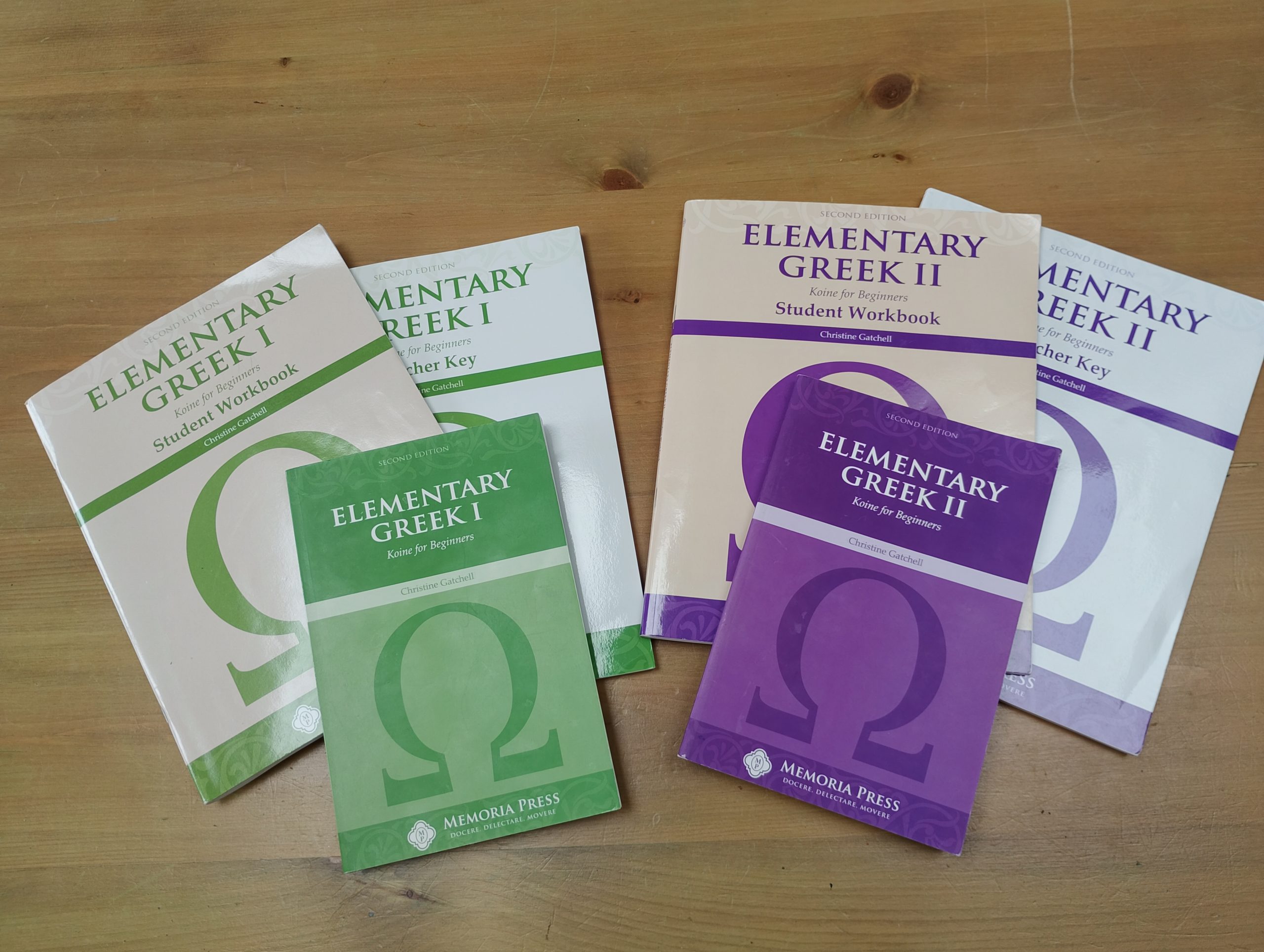
Memoria Press Elementary Greek: a review
This post contains affiliate links. As an Amazon Associate, I earn from qualifying purchases.
This review is intended to share our experiences of working through Elementary Greek curriculum Levels 1 and 2, by Christine Gatchell. It covers questions such as how we used the course, what we had used previously, areas of particular challenge, and what we moved onto afterwards. I am also a beginner Greek learner, and used this course alongside my child as an introduction to Greek, trying to stay a few weeks ahead! I therefore feel pretty well equipped to write about using Elementary Greek as a beginner, but less well equipped to offer a comparison to other introductory Greek courses, or questions such as whether to begin with Koine or Attic.
- What did we use before Elementary Greek?
- Are you studying any other foreign languages?
- How we used Elementary Greek
- Using Elementary Greek as an adult beginner
- Using Anki flashcards alongside Elementary Greek
- What did we move on to after Elementary Greek?
- Final thoughts on Elementary Greek
What did we use before Elementary Greek?
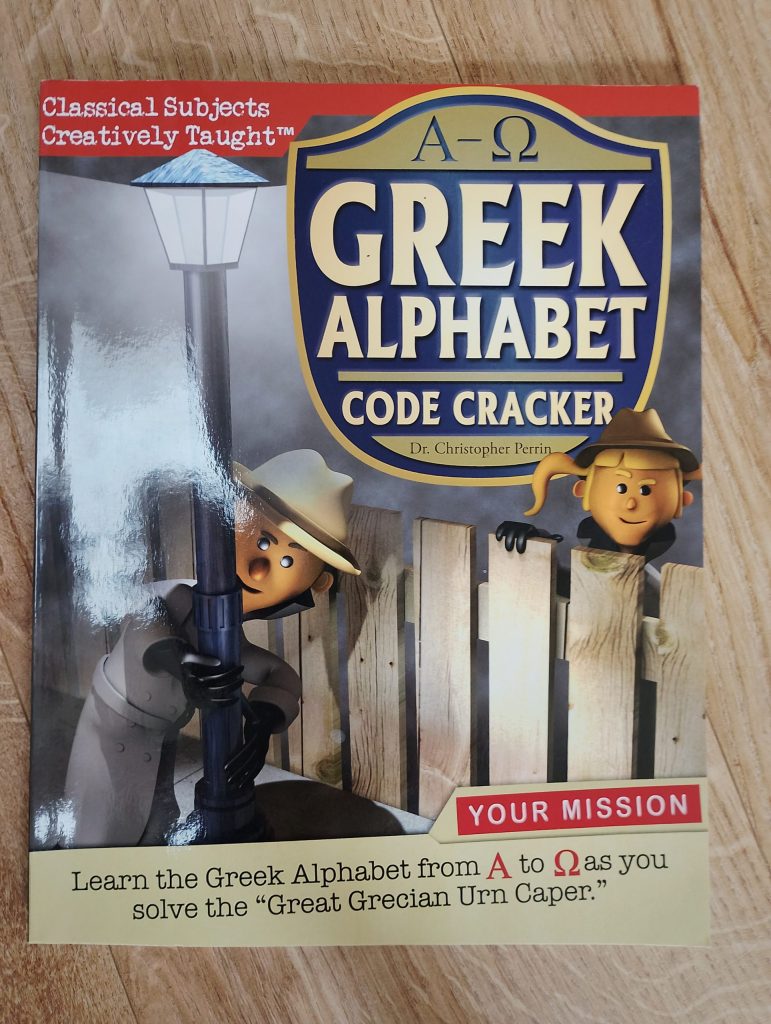
My student used the Greek Alphabet Code Cracker workbook from Classical Academic Press during the summer before we began studying Greek. I bought it on a whim because I thought they would enjoy the book, and it would give an indication as to whether they were ready to begin studying Greek more earnestly. The Code Cracker was a hit, and my child was able to learn the Greek Alphabet painlessly in this way. We therefore decided to give Elementary Greek a go at a gentle pace.
If you are looking to source Code Cracker in the UK, I found christianbook.com to be reasonably priced.
Are you studying any other foreign languages?
Yes, my student was already studying French and Latin before beginning Greek. It is completely normal to learn several foreign languages where we live (Europe) so I wasn’t concerned about confusion between the different languages, but I did want to make sure that my student was not overloaded. I therefore wanted to pick a gentle introduction to Ancient Greek which would not be overwhelming or disheartening. I hoped that Latin in particular would be a good introduction to Greek grammar.
How we used Elementary Greek
We found that Elementary Greek was so gently paced that we were able to progress at a rather faster pace than suggested by the curriculum. Each level has 30 weeks of instruction. Generally each week has a Bible verse and vocabulary memory day, three days of suggested work and a fifth review day. We really enjoyed the Bible verse translation and memory activities. It was a great motivation to keep pressing on with learning Greek, as we were able to understand simple Bible verses in the original language!
My child already knew the alphabet from Code Cracker, so we were able to move through the first two weeks very quickly. From then on, my student generally completed a workbook page every day, which took 10-15 minutes. As there are often 2 ‘days’ worth of lessons on each workbook page, we were able to finish Level 1 in approximately six months. The last few weeks in Level 1 and the first few weeks in Level 2 are review, so these also went rapidly, and within the same school year we were able to reach Week 22 of Level 2.
My student generally worked independently, and the curriculum is well designed for this. The progression is very gentle and incremental, and there are plenty of review activities built in. I tried to mark the workbook daily and give fairly immediate feedback on any areas of difficulty. We also worked on the skill of ‘self-assessment’. That is, if my student could not remember a paradigm or complete a sentence translation, I would encourage them to look up the required information in the textbook, and then complete the work in a different colour to remind them that this was an area which needed more practice.
I also uploaded each week’s new vocabulary (generally 5 words per week) into Anki flashcard software for review and study. I have written more about this below.
We did not purchase the audio resources, but I did find these Youtube videos by David Luchford on Greek pronunciation very helpful. I understand that there are a range of opinions on how to pronounce different sounds in Ancient Greek, and I wanted to aim for a for a fairly typical British pronunciation.
On this note, we generally decline nouns in a different order in Britain from that used in the United States (we go NAGD rather than NGDA) and I taught my child to chant and to write in this order. We just crossed out and rewrote the Case instructions in the workbook as we went, which did not present a problem.
Using Elementary Greek as an adult beginner
As an adult, I was able to move fairly rapidly through the course, because it was easier for me to make judgement calls about what areas need more practice and what review activities I could skip because I already knew the material confidently. The textbook was very useful, it usually explained any questions that I had, and I only occasionally had to look up information elsewhere.
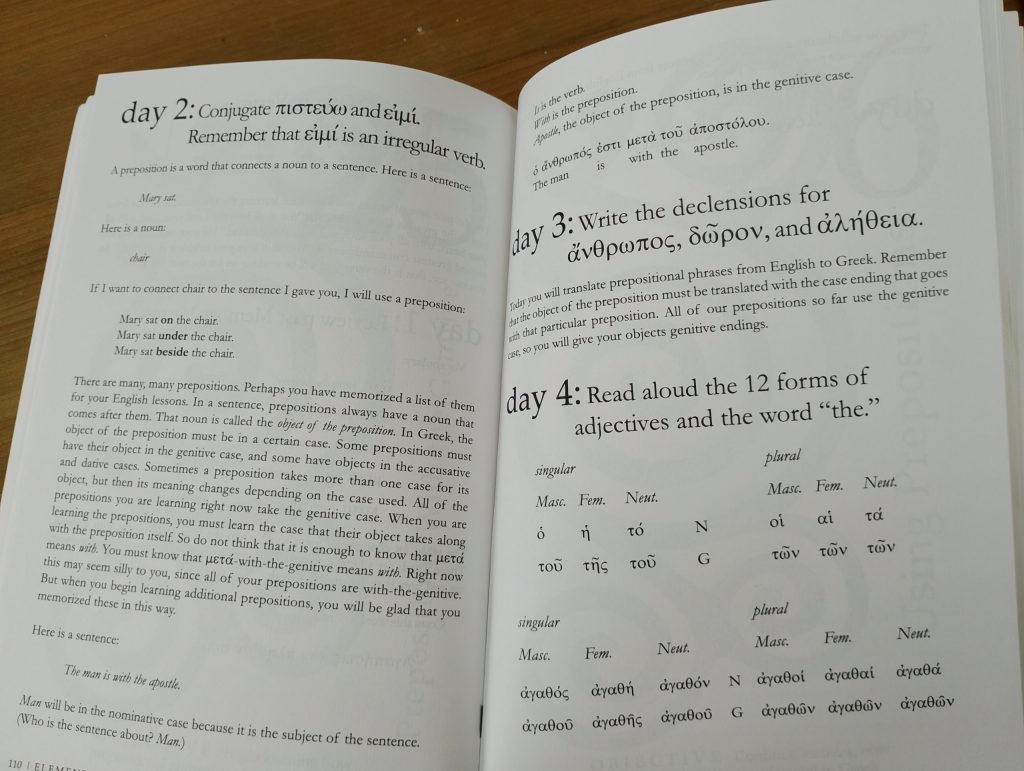
I found Elementary Greek a very easy resource to use to teach my child as a beginner, and to model learning a new skill.
Using Anki flashcards alongside Elementary Greek
We use Anki quite extensively for foreign language vocabulary drill, and find it very helpful. Anki is a free spaced-repetition virtual flashcard system. You upload each new vocabulary word as a card, and the software arranges how often to show you the flashcard, based on how well you are able to remember each word. We have our Anki cards set up to review both Greek into English and English into Greek.
I tried to help my child to think of English word roots for as many new vocab words as possible, to aid with memorisation. The author, Christine Gatchell, does often make these links in the textbook, but we managed to make connections for quite a few additional words.
What did we move on to after Elementary Greek?
Elementary Greek has three levels available. After a year of study with Elementary Greek (reaching Week 22 of Level 2) I felt that we were ready to move on to a faster paced curriculum. I looked into Athenaze but ultimately decided to go with Greek to GCSE by John Taylor. We have had good success with Latin to GCSE in the same series, with very clear grammatical explanations, good progression, and plenty of practice at translating both ways.
This change of curriculum did involve moving from Koine to Attic Greek, but I think I had always intended to make this leap once we were confident in the basics. Most people say that if you understand Attic Greek then it is fairly easy to understand Koine, but not vice-versa.
After our great experience with Elementary Greek I did decide to incorporate plenty of review activities along the way, which is one area which Greek to GCSE does not cover so well.
Final thoughts on Elementary Greek
Elementary Greek has really exceeded my expectations as a beginner Greek curriculum. It is so clear and easy to use, that even quite young children should be able to use this course fairly independently. The review activities are very good for the student’s confidence, keeping everything clear and well-memorised. I felt that my student was too young to launch independently into most Greek curricula, which are designed for teenagers and adults. However, after a year with Elementary Greek, they have a good basic grounding and the confidence to move on at a faster pace.
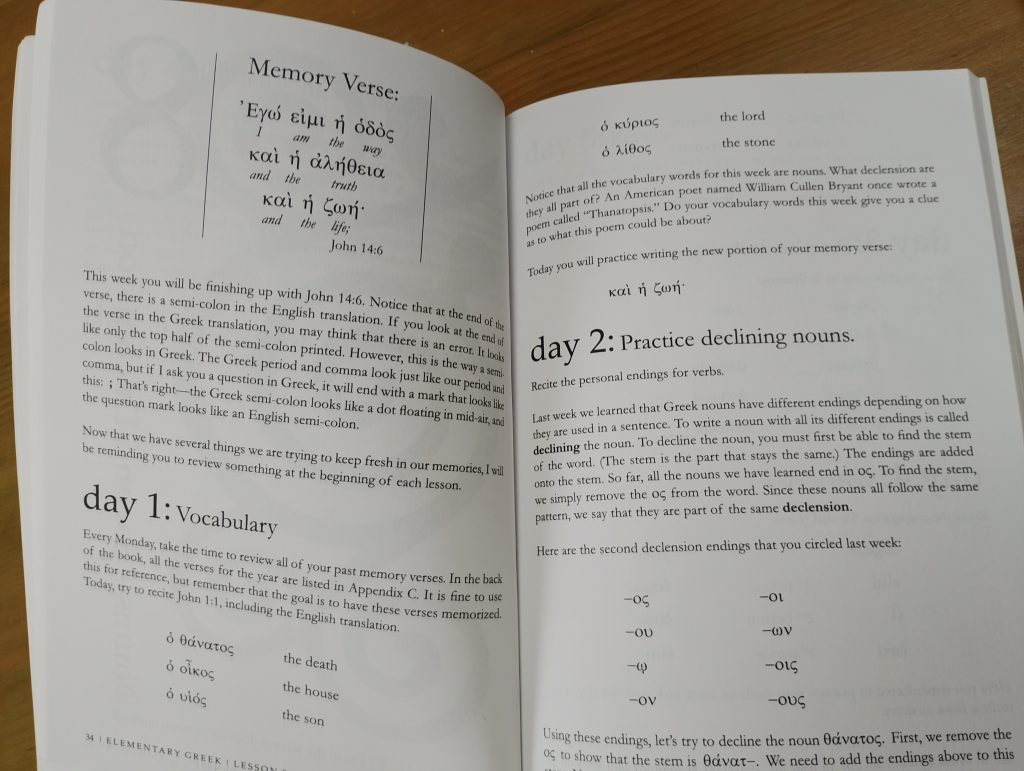
I also really enjoyed the Bible verse memory work which is included from the beginning of the curriculum. I found this to be an excellent encouragement to keep progressing, as my ability to translate the Bible improved.
The pacing of Elementary Greek is very very gentle, so it probably would not be the most efficient choice for an adult or teenager, but it is certainly possible to speed up the curriculum if you find that the pace is too slow for your student.