
Using Ronit Bird’s books to help a child with dyscalculia – a parent’s review
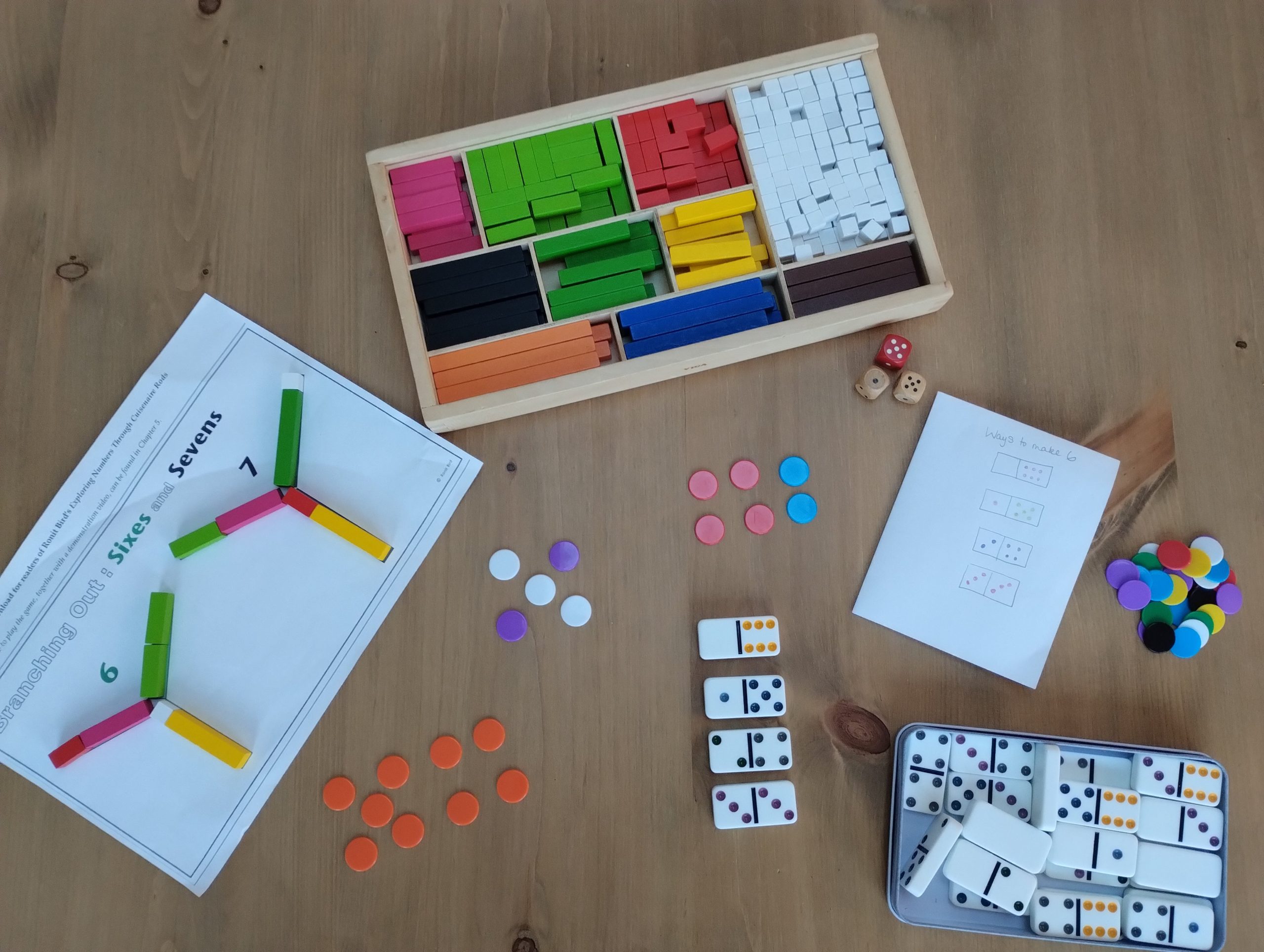
This article is a review of Ronit Bird’s dyscalculia materials, based on using them to help one of my children. So far, we have used all of ‘Exploring Numbers Through Dot Patterns’ and most of ‘Exploring Numbers Through Cuisenaire Rods’.
By ‘dyscalculia’, I am referring to a persistent and serious difficulty in understanding numbers. It can particularly affect subitising (being able to quickly see how many objects are in a group), use reason to answer maths questions (e.g. 3+4 cannot be 2, because that is smaller than either number), or ‘feel’ the relative size of numbers such as 14 and 40. It is also often accompanied by poor working memory, making it difficult for a child to keep track of the steps of a calculation in their head. Ronit Bird has a helpful list of markers on her website here.
There are relatively few resources available for children with dyscalculia. Of those resources which we have tried, I would say that Ronit Bird has been the most useful for overcoming dyscalculia. She has worked extensively with dyscalculic children as a tutor, so she has had lots of opportunity to try out different strategies. Ronit Bird’s books, games and activities are not flashy, but they do work. Slowly but surely they have enabled a game-changing level of progress in numeracy for my child.

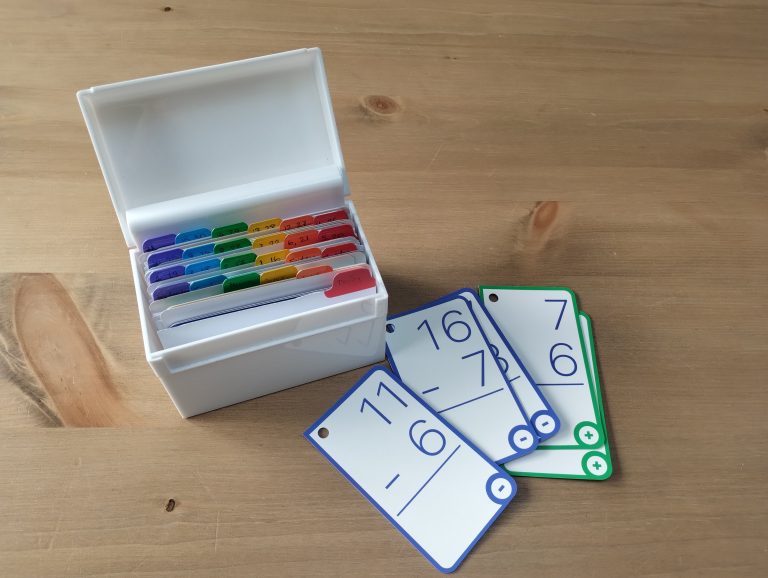
I should say that I use Ronit Bird’s books alongside a broader maths curriculum (Maths with Confidence by Kate Snow), and also a system of spaced-repetition maths fact flashcards, reinforced with visualisation strategies. I hope to come back and discuss those aspects of our maths work in a future article.
Exploring Numbers through Dot Patterns
Exploring Numbers through Dot Patterns is the first e-book in Ronit Bird’s series, and it is deceptively simple. The basic idea is to use visualisation techniques to help dyscalculic children to get a ‘feel’ numbers and understand how to manipulate them.
The first few chapters use ordinary dice dots for the numbers 1-6. These can be drawn, and she also encourages children to ‘build’ the patterns using counters or beads. There are ideas for how to teach the concepts of even and odd, and double and half.
Once a child can confidently identify the dice dot patterns, you can then move to seeing smaller numbers inside those patterns. For example, 6 can be made out of a 4 dot pattern and a 2 dot pattern. 5 is a 4-dot pattern with a 1-dot pattern in the middle. In my opinion, this is absolute gold for teaching a dyscalculic child. My child was not able to easily ‘visualise’ a ten-frame in their head. They had much more success with visualising and splitting dice dot patterns.

Once a child is confident with manipulating numbers and patterns up to 6, the book introduces dot patterns for the numbers 7 to 10. For example, a 7 dice dot pattern is made of a 4-dot pattern and 3-dot pattern next to each other. Once a child has learned these patterns, they have already learned a core fact family for each number (e.g. 4+3=7, 7-3=4).
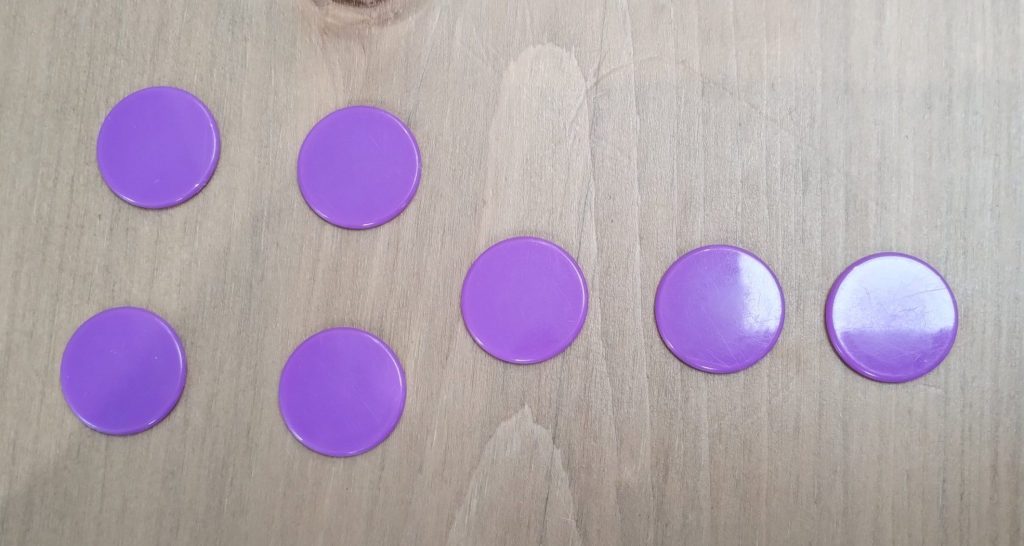
The book then provides lots of strategies and games to help with manipulating these larger dice dot patterns to learn other facts. In particular, there are lots of domino games working on combinations of dot patterns which sum to a larger number.

How we used the book
I should say at the outset that we made one attempt with the book at the younger end of age 6, which didn’t work out. My child enjoyed the games, but was not absorbing and using the visualisation strategies unless the manipulatives were in front of them. We came back to it six months later with much more success. I guess that they just needed a bit more time and brain development to be able to do this.
I had read reviews from other parents who children had been able to work through this book and absorb the content in under a month. This was not the case for us! My child was perhaps at the younger end of users (age 6-7 roughly), and it took us 9 months to get through Exploring Numbers with Dot Patterns, using it for short sessions roughly three times a week.
Some activities would only need one session, but often we would need to pause in a chapter and go over the various games and activities a number of times to cement them. The goal was for us to repeat these visualisation strategies with manipulatives, and then with drawing, and then mentally, enough times for them to stick in my child’s head, which varied quite a bit from number to number. Some activities, like arranging domino facts for a particular number into a pattern, needed a good amount of time to sink in, but felt very much worth the effort.

I also used this program to support learning maths facts, with spaced-repetition flashcards. We were not just drilling flashcards, we were developing and using visualisation strategies for each new fact, based on these dice dot patterns. E.g. we would learn the dice-dot pattern for 7, and then I would add the facts 4+3=7 and 3+4=7 to our flashcard box.
I think that Ronit Bird’s visualisation strategies have really unblocked my child’s progress in maths, and their ability to actually understand and calculate basic addition and subtraction facts mentally.
Exploring Numbers through Cuisenaire Rods
Exploring Numbers through Cuisenaire Rods is the second book in Ronit Bird’s e-book series. We are about half way through this book, but we have found that we have made much faster progress than in the first book. I think the first book was quite foundational for my child, and now they are able to use strategies from the first book, such as patterns of one more/one less, to help them with this book. They are now quite confident with maths facts within ten, which has helped with a lot of the early activities. My child also had a reasonable amount of familiarity with Cuisenaire rods before beginning with the book.

Nevertheless, there have been a number of activities which my child found surprisingly challenging. For example, we used Cuisenaire rods to estimate the length of different items, and they found it surprisingly hard to find items which were, for example, ‘longer than one 10-rod but shorter than two 10-rods’. Recording rod patterns on graph paper also clearly required a fair amount of concentration.
We are reaching the section of the book which I am hoping will really help us at our current sticking point, around ‘bridging’ through tens when adding and subtracting larger numbers, and I hope to report back here when we have finished the book as to how it goes for us.
Why e-books?
The books are in an e-book format to enable Ronit Bird to include video demonstrations of many of the games and activities in the book. I used some of these, but not all. Generally the activities themselves are very straightforward, but it can be helpful to hear how she leads the discussion with a child to move on their mathematical understanding.
Where can you find Ronit Bird’s resources?
Ronit Bird’s e-books are for sale at Apple Books, and also in an EPUB format from her website. You can view and print some of the game boards from the books on her website here to get a feel for the types of activities.
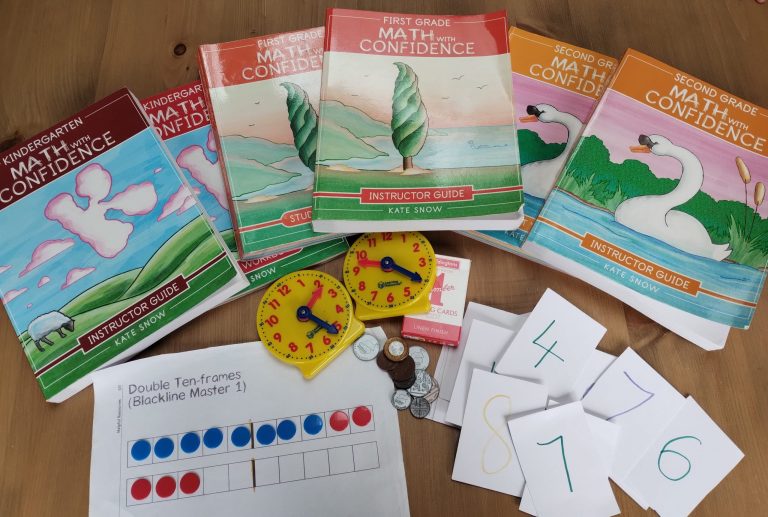
Thank you for this article. I have been using math with confidence and we are going into grade two, but I have a struggling learner. So I was going to try adding Ronit Birds books to my son’s home schooling. Just wondering how you used it with math with confidence? Not sure if I should just be using Ronit Birds books first till he masters his addition and subtraction facts? He is dyslexic as well as has a bit of expressive receptive language. It took him a really long time to recognize letters and numbers, he could sing and count fine but it was the recognizing part that took a really long time. Or if I should do some days math with confidence and than other days to it Ronit bird games? Any suggestions would be great.
Hi Rachel,
I have tried different approaches to combining MwC and Ronit Bird at different times. Generally we do MwC every school day, and we add in Ronit Bird on some afternoons as a supplement. There have been a couple of times when it has been helpful to take a week or two off from MwC and give time for ideas to consolidate, so we have done more Ronit Bird. During holiday periods when we are at home, I will often focus more on Ronit Bird’s resources. I find that it is helpful for my child and I to be using a number of resources concurrently and pushing forward on a number of different mathematic fronts. That way, even if we are stuck on some things, there is still a sense of progress and success.
As regards whether to move forward into MwC Grade 2, I think it depends how much work is needed on addition/subtraction facts. If you have mastery of facts within 10, there is a good amount of review of facts to 20 in the early part of MwC Grade 2, and you may find that it all comes together. If you are still working on facts within 10, I would probably pause MwC and do some concentrated work on Ronit Bird’s dot pattern resources, and see if you can get some breakthroughs.
I hope that is helpful – do feel free to come back with further thoughts.
All the best!
Thank you so much for the reply, really appreciate the suggestions 😀