

How I teach my children to read: Choosing decodable phonics readers
This series of articles is for parents who are considering teaching their child to read themselves. I think it is one of the most rewarding things you can do as a parent. Definitely worth having a go! Having taught several of my children to read, here is my favourite step-by-step method. The headline is: prioritise phonemic awareness first, introduce phonics in a logical order, and use lots of fun decodable readers.
In this third post, I review several different reading schemes of decodable phonics books, to help you decide what would be a good fit for your child.
Articles in this series:
- Phonological awareness
- Phonics stages overview for parents
- Choosing decodable phonics readers (this article)
- What next? Early chapter books
In the early stages of learning to read, I try to choose reading books that are almost entirely decodable using the sounds that a child has already learned. There will be very few ‘sight’ words, and if these are present they will be extremely common words that children will come across frequently.
When introducing a new phonics grapheme (e.g. a new vowel digraph), we usually spend a few minutes with foam letters on a whiteboard playing around making a few words with that sound in order to build some confidence before tackling the new sound in a book.

Here are the reading schemes that I have used. In the beginning stages of learning to read, I really prioritise highly decodable schemes. Once a child is secure in their phonics knowledge, I place more emphasis on quality of content, syntax and illustration. If you want to, you can click on the link and go straight to my comments on the scheme you are considering.
- Dandelion Readers and Dandelion Launchers
- Julia Donaldson’s Songbirds Readers
- Read, Write, Inc
- ORT Traditional Tales
- ORT Non-Fiction
- Bug Club Phonics/Rigby Stars
- Usborne Young Reading
- Usborne Beginners
- Collins Big Cat
This post contains affiliate links. As an Amazon Associate, I earn from qualifying purchases.
Dandelion Readers and Dandelion Launchers
Phonic Books
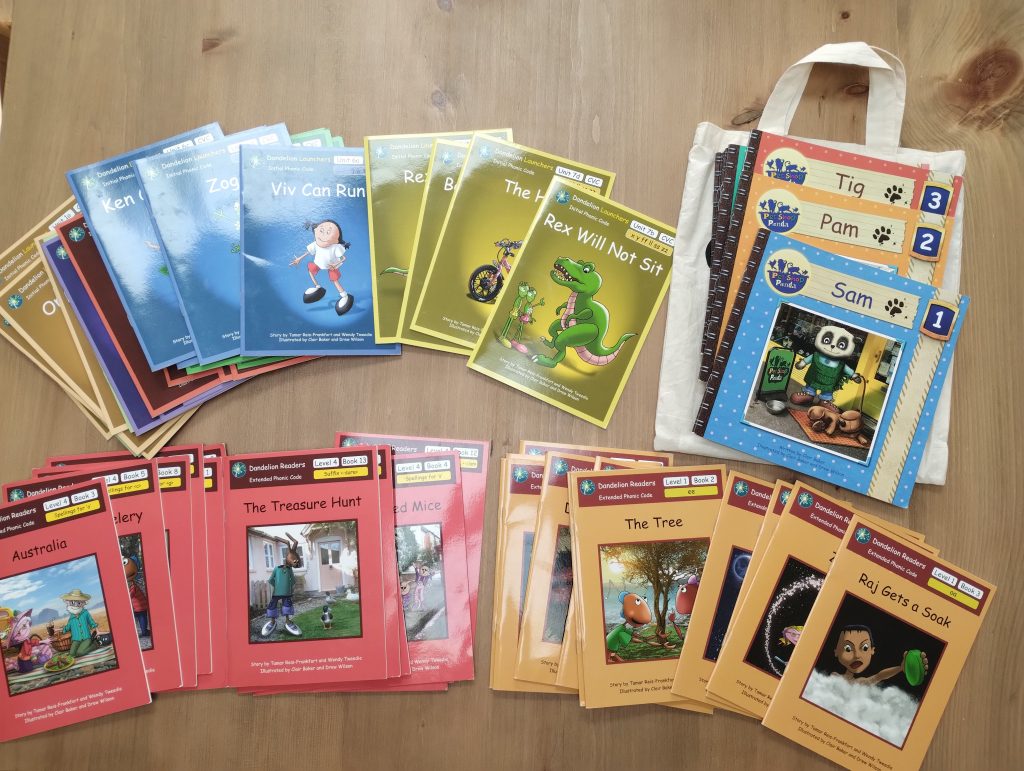
This is the most decodable reading scheme that I have come across, and is very finely graded. The earliest books use as few as four to six single letter sounds. The stories are very short, and feel achievable to a child who is only just starting out and blending words quite slowly.
Pet Shop Panda
The shortest and simplest stories are the Pet Shop Panda series and the Dandelion Launchers. Since I purchased our readers, Phonic Books (the publisher) appears to have been bought by Dorling Kindersley, and some of these books are being republished with updated illustrations. There now appear to be more books available in the Pet Shop Panda series. Unfortunately, the Phonic Books website has become less helpful than it used to be, and it is harder to tell where, say, ‘Haircut Hippos’ and ‘Fix-it Foxes’ rank in difficulty and specific sounds used!

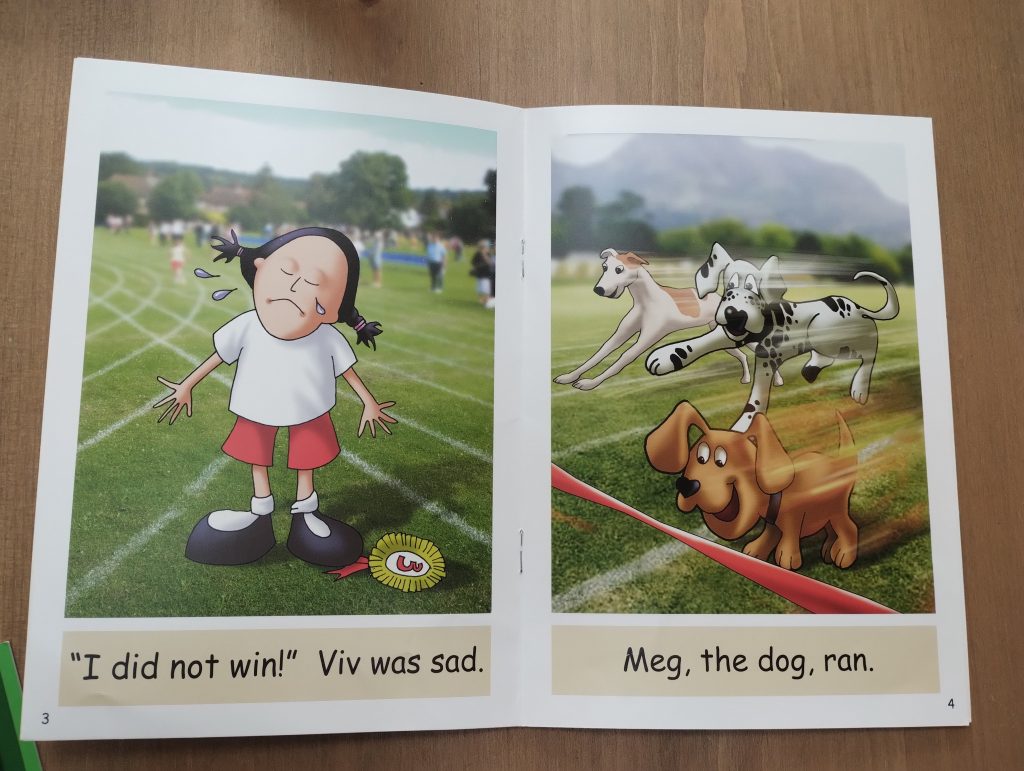
The two main series are Dandelion Launchers and Dandelion Readers, which both provide extensive and very finely graded progression of phonics sounds. The Dandelion Launchers are slightly shorter, being six pages rather than eight pages. These are all on the shorter end of reading books, so they are very achievable for children who are slower to decode, or sometimes become frustrated.
Dandelion Launchers
- Units 1-3 covers the sounds s,a,t,i,m,n,o,p,b,c,g,h
- Units 4-7 covers the sounds d,e,f,v,k,l,r,u,j,w,z,x,y,ff,ll,ss,zz
- Units 8-10 covers the consonant clusters at the beginning and end of words
- Units 11-15 covers the core consonant digraphs ch,sh,th,ck,wh,ng
- Units 16-20 covers tch,ve, and lots of practice at two syllable words

Dandelion Readers
Units 1-20 cover a similar progression to the Launchers books. I chose the Launchers, because I could buy them in smaller chunks of units, with more books in each unit. I have typically found that my children have found this earliest stage of reading (blending words with single sounds) the hardest, and we need plenty of books to practice!
Extended Phonics Code Levels 1-3 are best explained by this helpful chart on the back of the books. Essentially, each book focuses in on a particular vowel digraph. At the first level, only one possible variant is used, but this is gradually expanded to include multiple options as the student becomes more confident. I have only used Level 1, as I have other resources (e.g. Songbirds) for additional work on these vowel digraphs.

Extended Phonics Code Level 4 is gold, in my opinion. It gives extensive practice at suffixes (e.g. tion, ture) and more unusual phonics combinations such as PH, SC, and soft G and soft C.


The Dandelion books are absolutely fantastic for being decodable and for gradual progression. The stories aren’t quite as riveting as, say, the Songbirds books described below. I particularly like to use this series for the earliest blending of single sounds, as it offers lots of practice, and for the final Extended Code Level 4, practising more unusual combinations to build confidence before moving on to ‘normal’ books.
Julia Donaldson’s Songbirds Readers
Oxford University Press

These are the most enjoyable decodable readers I have come across. My children really like them! You can typically get a core set of 36 books (six at each stage) for just over £1 a book online, which I think is a very reasonable price.
There are actually 12 books available for each of the first four Stages, and then just the six in the bundle for Stages 5 and 6. and if you want to pick up the second sets of six books for Stages 1-4, you will need to spend more money, or you can buy them bundled into a 6-in-1 volume. I prefer individual books for little hands, and try to pick them up cheaply on eBay. The 6-in-1 volumes are often available in UK libraries, so that would be a good place to check.


At the end of Stage 6, in my experience my children have still needed a little extra ‘boost’ before going on to non-decodable readers, so we have moved on to the Dandelion Extended Phonics Code Level 4 mentioned above, for some extra practice on suffixes.
Songbirds Activity books
One of my favourite things about the Songbirds books is that activity books are available, with pages to accompany each story. These are well done, with colourful pages and stickers for completing each activity. I tend to teach my children to read before teaching them to write, so I appreciate that very minimal writing is required for the first couple of activity books. There are four activity books, spread over the six Stages of books.
ATTENTION! Take care over the Songbirds stage labelling!
Very confusingly, OUP operate two different guides to levelling books, one for schools and one for parents. The Songbirds readers themselves are labelled using the schools system, with Stages 1-6 corresponding to book bands pink – orange. However, the accompanying activity books, and the bundled 6-in-1 readers, which are marketed to parents, are labelled using the parents system with Stages 1-4, which spread over the equivalent Stages 1-6 for schools. I don’t know why OUP does this, as I find it really confusing. Do take care that you are purchasing resources at the level you intend.
One other note is that there are a couple of books in this series that I dislike. One is ‘Gran is Cross‘ where the grandmother gets very annoyed with her grandchildren about a series of unfortunate events. The other is ‘Back to Bed‘ where the parents go out for the evening, and the children are very badly behaved for the babysitter. When the parents come home and ask how the evening went, the babysitter lies and says it went well, with her fingers crossed behind her back. This was baffling to my children, and it took a lot of explanation about the lie, why she lied, what the crossed fingers mean, for them to grasp the ending of the book. It isn’t something I really wanted to dwell on with a small child. Otherwise, I really like this series, but I wanted to include this caveat!


Read, Write, Inc
Oxford University Press
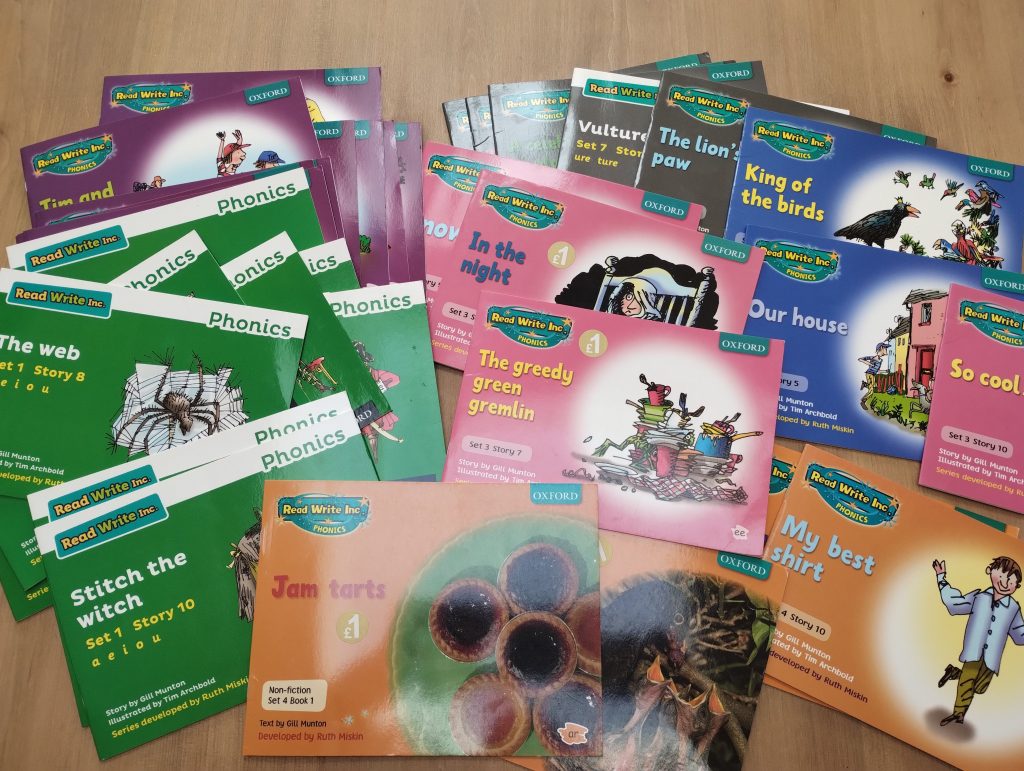
To my mind, the Green Set 1 books start at a slightly higher level than some of the first books in other series I have. There is a Red ‘Ditties’ set which are simpler, but there isn’t much of a story to these. I do have a set of Red Ditties with a couple of very simple word flip books, which I really like as a ‘first’ book for children who are just beginning to blend. However, I haven’t been able to find these word flip books sold on their own.


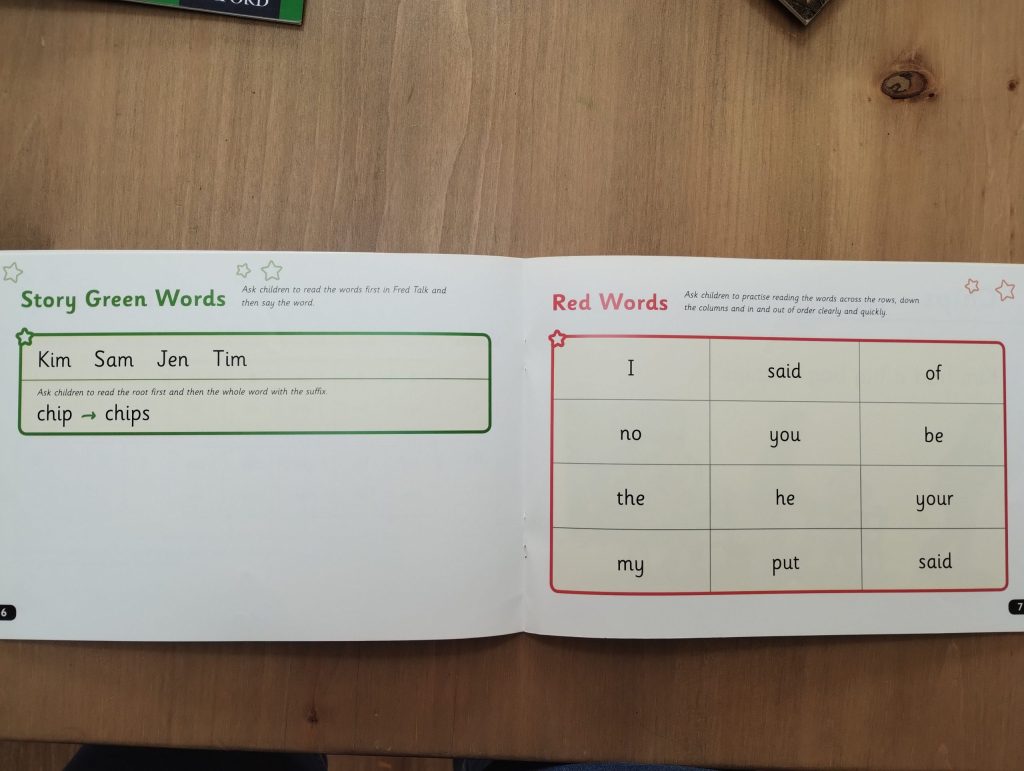
One feature of RWI which I like is the introductory ‘green words’ page. This gives children an opportunity to practice the new concepts and trickier words they will meet in the book. The words are broken down into syllables to make them easier to decode.


By the time the RWI series reaches Set 6 (Blue) and Set 7 (Grey) the books are seriously challenging, both the decoding and the vocabulary. One of the stories in set 7 is Androcles and the Lion:

This is not my favourite series, but it is a solid option. The plotlines don’t really grab me as much as some of the other reading schemes, and it doesn’t have quite such good gradation of decoding as Dandelions to compensate. There are quite a few witch stories and spooky stories, and though these are silly, I don’t love them.
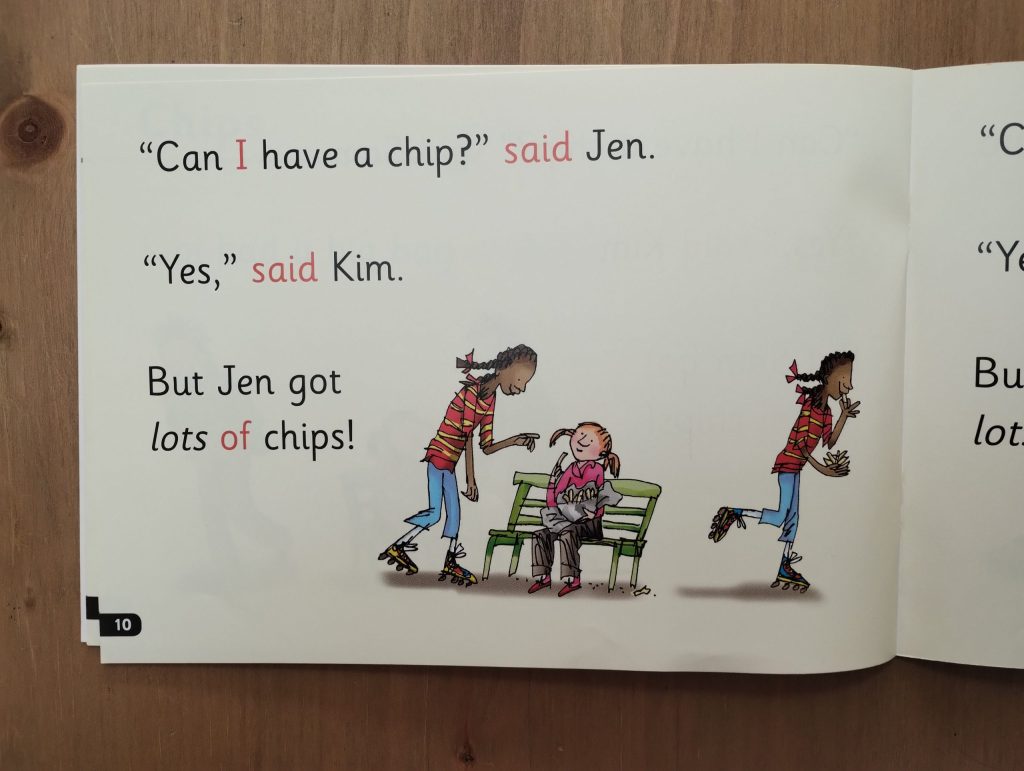
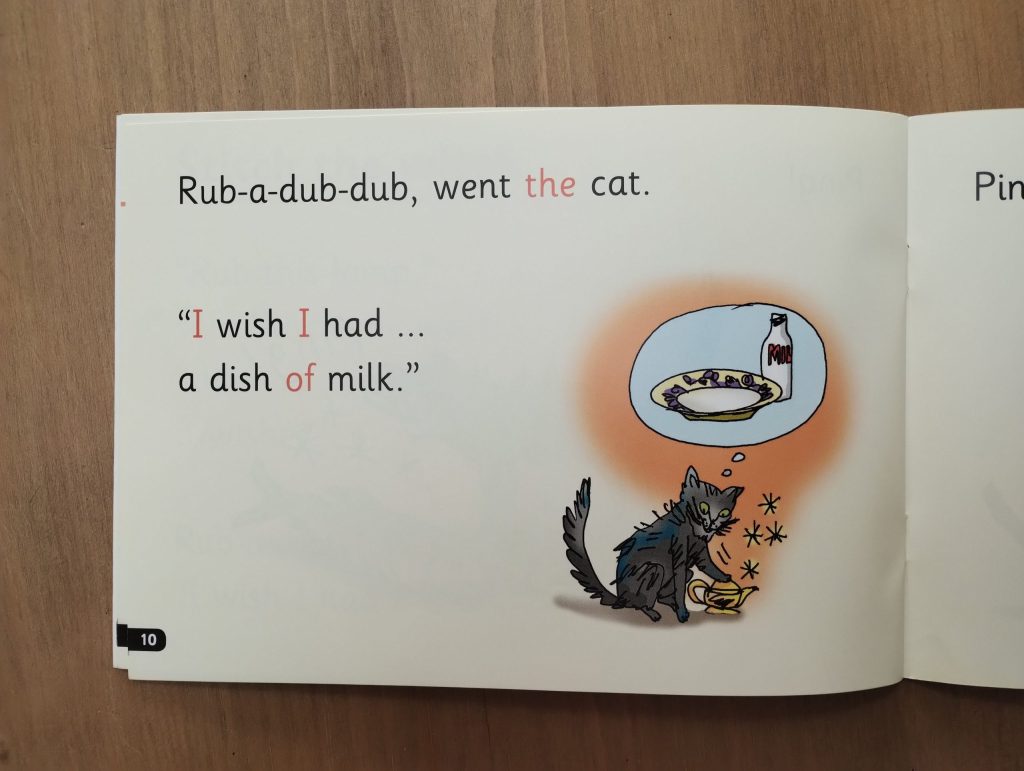

It is possible to purchase much cheaper copies of these books with black and white illustrations rather than colour illustrations.
ORT Traditional Tales
Oxford University Press
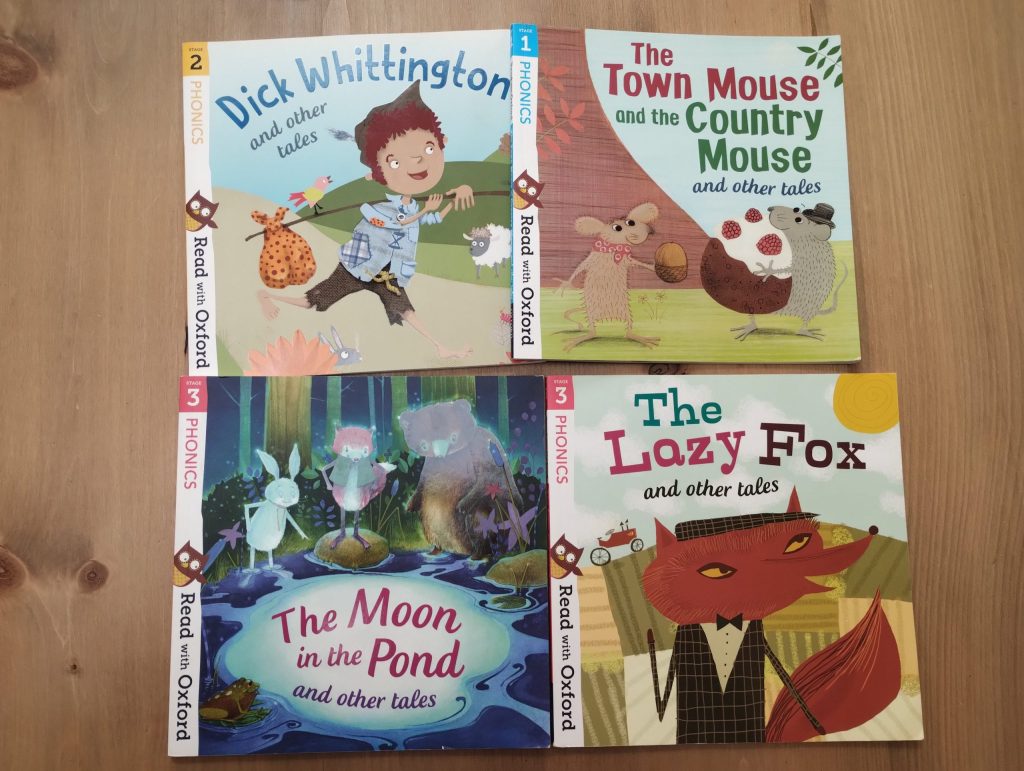
This is a nice series of traditional stories and fables, graded by phonics level for ORT Stages 1-6. You can purchase them in sets of four books. Confusingly, from Stage 2 onwards, the books are compiled into sets of e.g. two Stage 2 and two Stage 3 books, rather than putting all Stage 2 books together.


They are well illustrated, and I enjoyed the range of stories, some of which will be very familiar to children, and some from other cultures which may be new.
To find these volumes of four stories online, rather than the schools editions, it is helpful to search for ‘Read with Oxford’.
ORT Non-Fiction

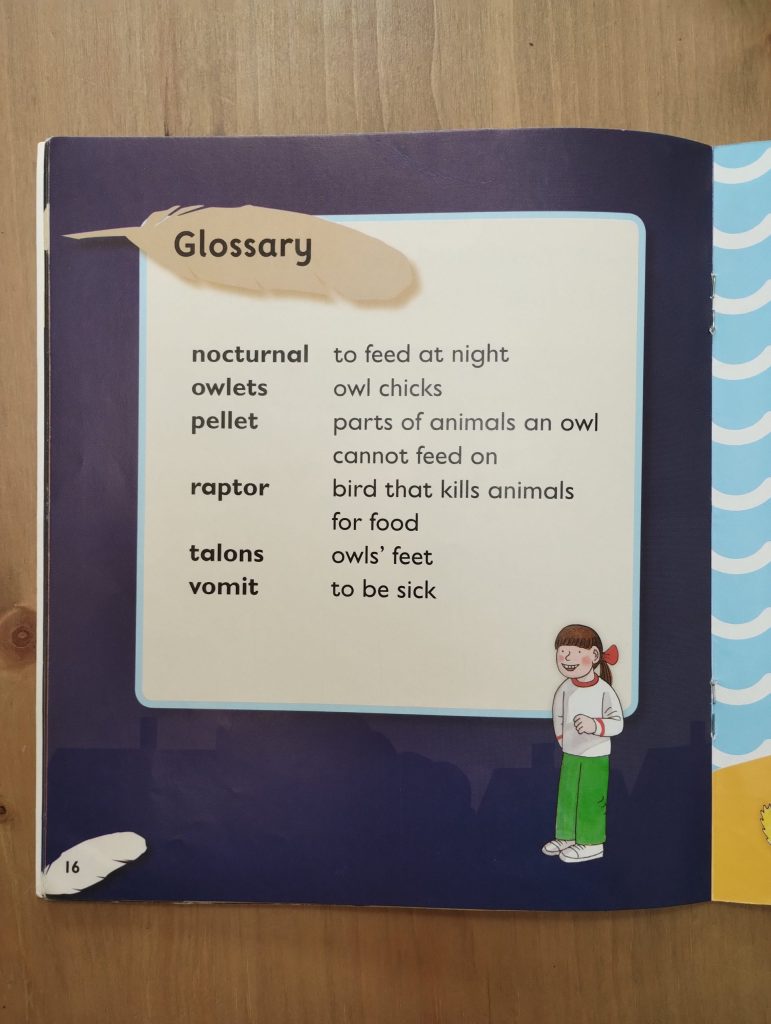
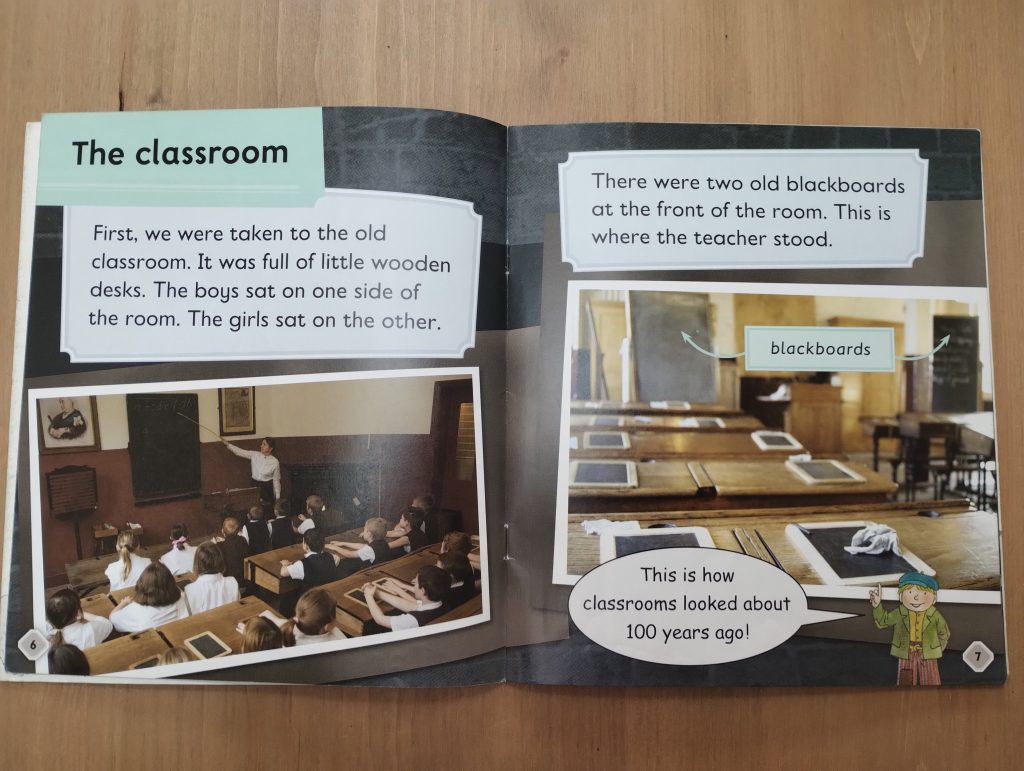
The Songbirds and Dandelion readers do not include any non-fiction, so I like to include some of these Oxford Reading Tree non-fiction books so that my children get exposure to contents pages, glossaries, and other features of non-fiction text. There are quite a lot of books to choose from, and I tend to choose a few at each level that look interesting, and purchase second-hand on eBay or similar. In my experience, these tend to be at the harder end of each Stage of phonics books, because they are slightly longer texts and sometimes have more technical vocabulary.

Bug Club Phonics/Rigby Phonics Star

This is not a series I have used extensively, but I picked up a couple of books for one of my children who needed more specific practice with soft C (e.g. dance) and soft G (e.g. giraffe). I found a good chart from Pearson online detailing what graphemes are covered in each book level.
The stories are well illustrated and engaging.


Usborne Young Reading
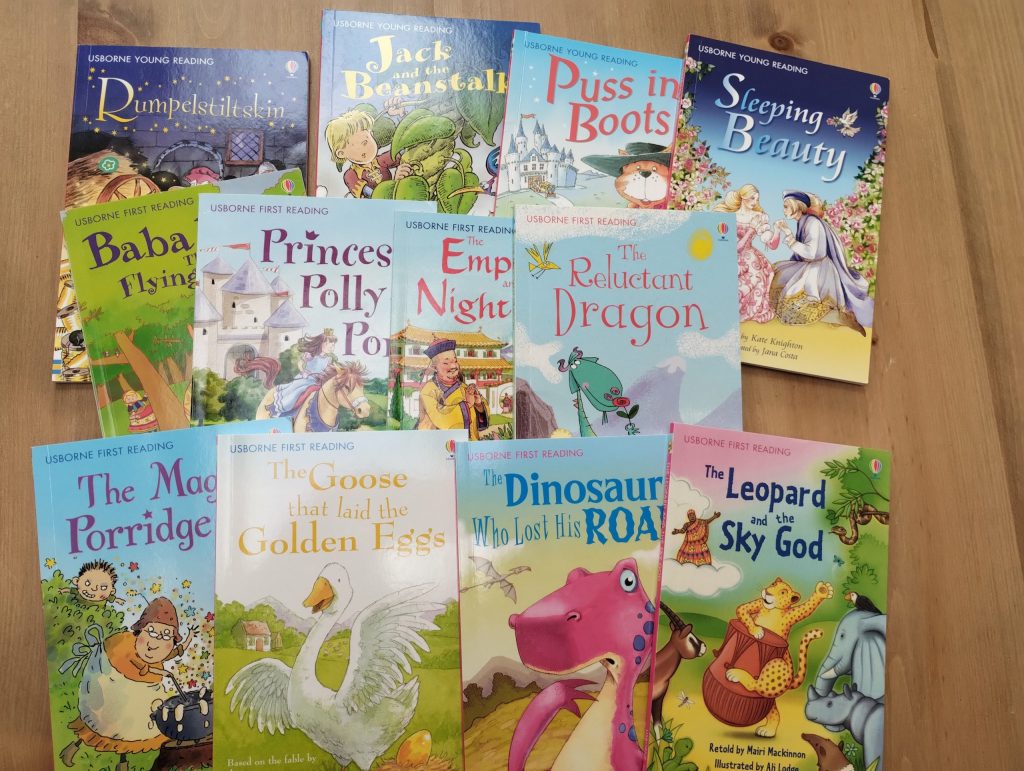
After graduating from decodable phonics readers, these are my favourite resource for progressing to longer, more complex texts, and getting ready for chapter books. You can purchase Usborne Young Reading books very reasonably in large box sets. We have My Second Reading Library of 50 books, which usually available at less than £1 per book.
This set has a good selection from First Reading 3, First Reading 4, and Young Reading 1. I have included some pictures below so that you can see the progression of the volume and complexity of text. Young Reading 1 is the first level at which chapters are introduced, and and at this point I usually start to only read part of the book at each sitting, as the books become so much longer. The books are mostly fairy tales and other popular stories, but there also some fun additions such as the poem The Owl and the Pussycat. They are very nicely illustrated. A couple are perhaps a bit gory for the more sensitive child (e.g. Ali Baba and the Forty Thieves, Baba Yaga, Hansel and Gretel), but you can easily skip these.

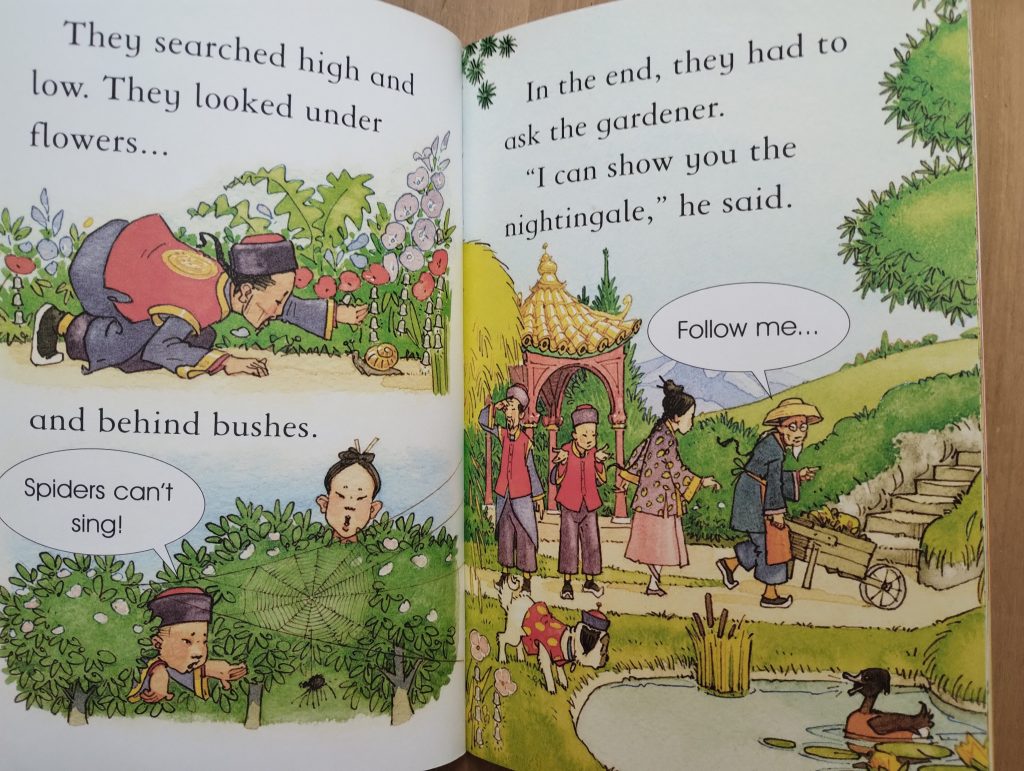

This box set contains books covering Book Bands 7-9 (Turquoise, Purple and Gold), and you can view the book bands for individual books here, and the lexile levels for the books here, which I find quite helpful reference points for choosing the order in which to tackle them. Lexile levels can sometimes be a bit off, but I generally find they give a decent idea as to the complexity of vocabulary and sentence structure.
Usborne Beginners
For non-fiction at the same level as the Usborne books above, I really like the Usborne Beginners books. They are available on a wide range of themes, and can be purchased in sets of ten at a reasonable price. I particularly like the History set and the Nature set.
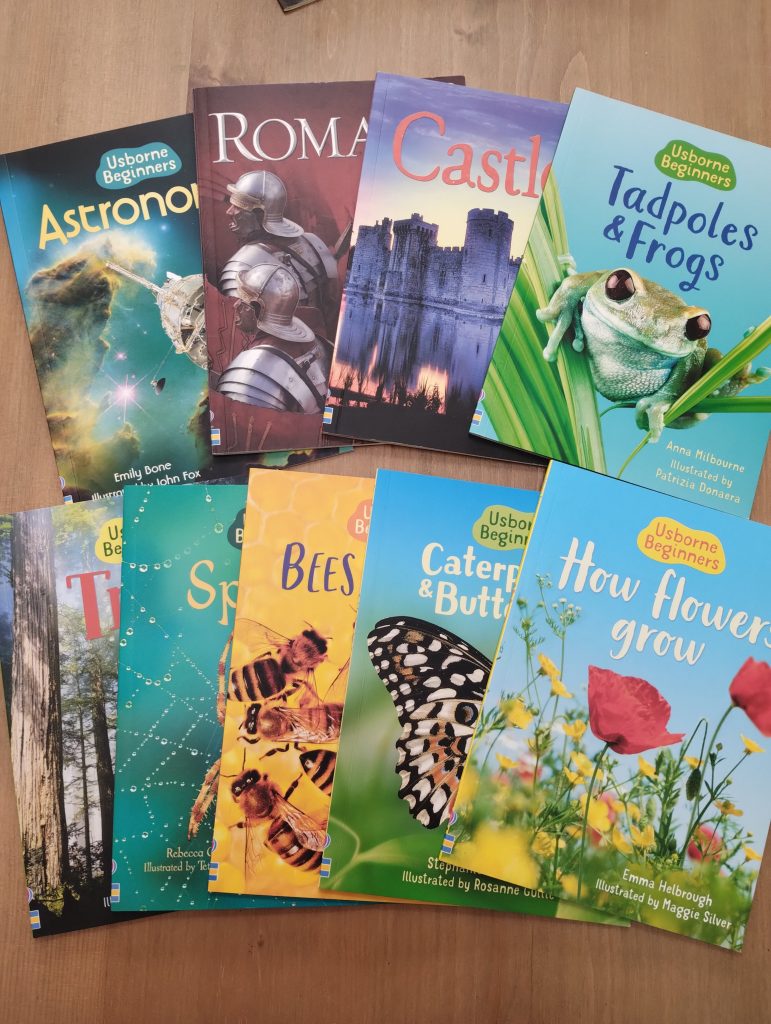
There is quite a progression of difficulty of vocabulary from the easiest texts to the hardest. I find it helpful to consult this lexile document to get a rough idea of the difficulty level, and try to use the easiest books in our sets first. All the books are Purple (Band 8) and Gold (Band 9) book bands.
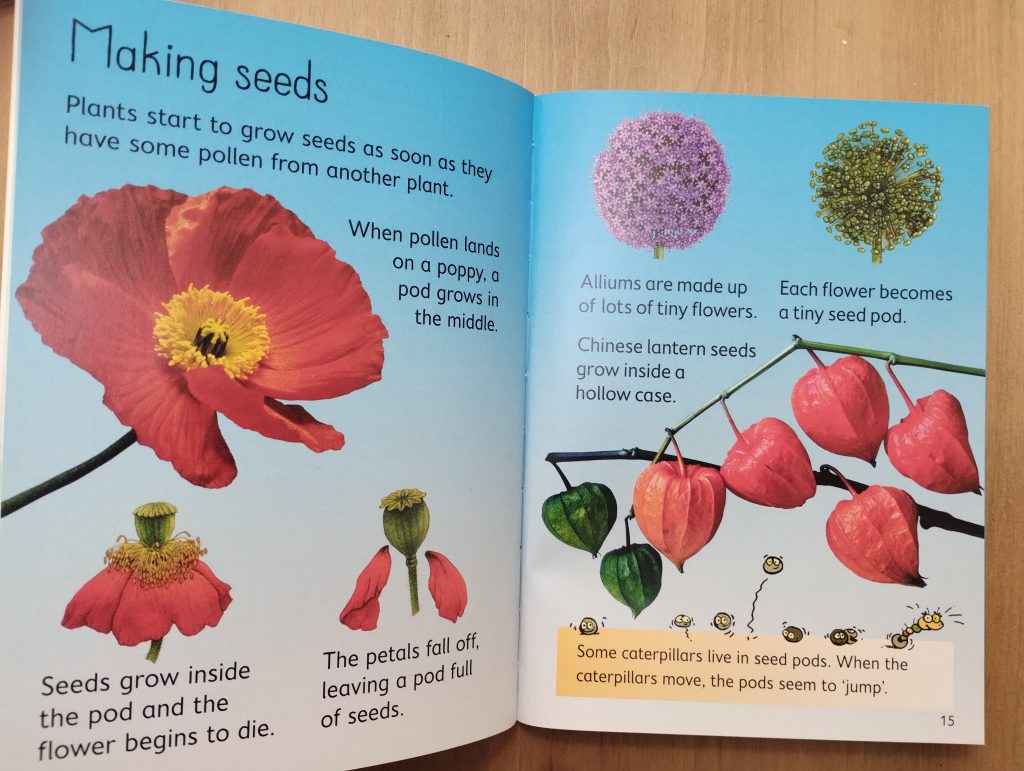

I have found that these books are often my children’s first exposure to certain topics (e.g. Volcanoes, Hurricanes, the Maya) and they can be quite captivated by these books, and have very interesting questions whilst reading them.
Collins Big Cat

One of my children needed some more comprehension practice with non-fiction books at a slightly higher complexity level, so I purchased some of the Collins Big Cat non-fiction books in Lime (Band 11) and Copper (Band 12). I found that there was a decent range of options available so that I was able to pick some which I thought my child would find interesting. We enjoyed these books, though not quite as much as the Usborne Beginners. I find it hard to put my finger on why!
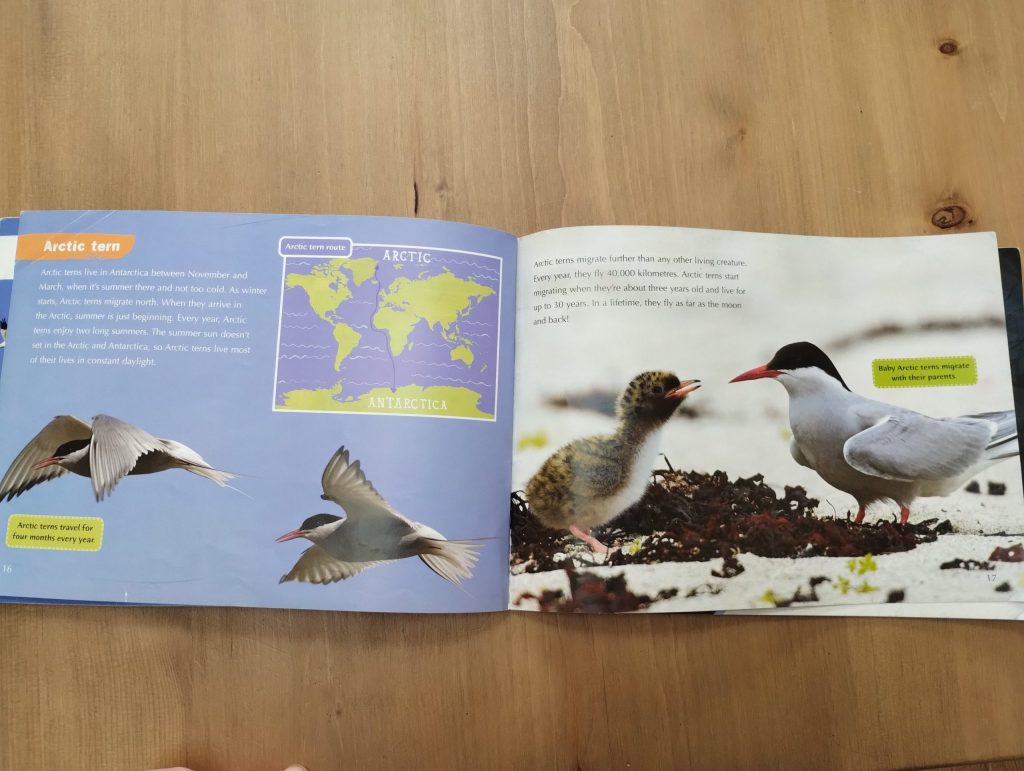

The book about chocolate (Chocolate: From Bean to Bar) was a particular favourite with my children!
You may be interested in the next article in this series, in which I review some early chapter books we have enjoyed.


