Maritime and naval history books for children
Books about ships are a particular interest for one of my children. Here are some suggestions for naval history books, and more general books about ships, for a range of ages. I have organised them broadly chronologically.
If you are in the UK, I would recommend a visit to the National Maritime Museum at Greenwich, which has some incredible artefacts, and also some wonderful paintings. I was absolutely blown away by Admiral Lord Nelson’s Trafalgar coat, complete with sleeve pinned up for his lost arm, and fatal bullet hole in the shoulder. The positioning of the bullet hole is very interesting. I could not at first understand how he could have been killed by a wound so high on the shoulder. The Nelson enthusiasts in the family explained that he had been shot from the rigging of a French ship, so that the musket ball went downwards.

In general the books from later time periods are more numerous and more interesting, but I have included a few books on ships from earlier time periods to give more of a spread.
- Roman ships
- Ships from the 15th to 17th Centuries
- 18th and 19th Century Naval History
- Polar Exploration by Ship
- World War II
Roman ships
The Lost Wreck of the Isis
Robert D. Ballard
This is part of the Time Quest series of books, which includes several volumes on the use of submersibles to explore various historic wrecks. In this book, archaeologists explore a Roman shipwreck on the seabed of the Mediterranean, nicknamed ‘The Isis’. The chapters alternate between explanations of the process of discovering and exploring the ship underwater, and a fictional story of events on board the ship leading up to it being wrecked.
The fact is that very little of the wooden ship remains; most of the wood has been devoured by marine organisms. The photographs and discussion are therefore mostly about the artefacts within the ship (amphoras, grindstones, etc) and the process of archaeological work within an marine environment, rather than about Roman ship design.
This is not my favourite book in the Time Quest series. There is perhaps an excessive focus on the submersibles and associated technology rather than the artefacts and wreck itself. However, it is unusual in covering very early maritime history, and therefore deserves a mention.


Ships from the 15th to 17th Centuries
Westward with Columbus
John Dyson
Another Time Quest book, this time exploring the recreation of Columbus’ ship the Nina, with a view to retracing Columbus’ voyage to America. The book is full of photographs of the replica caravel Nina, which give a good idea as to what sailing vessels were like in 1492.
As with other Time Quest books, alongside the non-fiction information there is a fictional story about the original events. This time it is the tale of a young boy travelling with Christopher Columbus. The pages of the story are interspersed with photographs of the modern-day caravel on its voyage, with crew members wearing 15th century style clothing. There are also a number of drawings and diagrams by way of additional explanation.
Again, this is not one of my favourite books, but particularly with the photographs and recreated sailing experience, it fills an interesting niche in explaining what it would really have been like to sail on a voyage of exploration to the west in 1492.


A 16th Century Galleon
Richard Humble and Mark Bergin
This is a very thorough information book in the Spectacular Visual Guides series. It has plenty of pictures and diagrams, describing the construction process of a 16th century galleon (e.g. the Mary Rose or the Ark Royal) and life on board. There are cross section diagrams, labelled pictures of the different sails, and descriptions of technical matters such as ‘how the rigging worked’ and the various tools of navigation. A lovely book for a child who enjoys really understanding how something works.


The Queen’s Pirate: Francis Drake
Sarah Courtauld
A title from the Usborne Young Reading 3 series, with plenty of pictures, a map of Drake’s voyages and a timeline. Drake was not a pleasant man, as events in the book make clear. In Chapter 2 Drake captures and transports slaves from West Africa to the Spanish colonies. At various points he abandons other men in battle to suit his own advantage. There is plenty of piracy. In Chapter 4 he has a man tried and beheaded for accusing Drake’s brother of theft.
The book includes some useful information on Queen Elizabeth, and a chapter on the Spanish Armada. It provides some helpful context for the enmity between England and Spain at this time.

The Boy who Fell Off the Mayflower
P.J. Lynch
Of the various books that we own about the Mayflower, this is my favourite. It tells the story from the perspective of John Howland, a young man on board the Mayflower. Every page has beautiful large illustrations, and the story is well told. I should note that it is a fictional embellishment of the life of John Howland, but there is plenty for the young reader to learn here about the history of the Mayflower. Roughly the first half of the book covers the voyage, whilst the second half covers John’s life in America.


18th and 19th Century Naval History
Sea Clocks: The Story of Longitude
Louise Borden
This is a lovely book about an apparently niche historical event which was actually very important. Sailors had long been able to work out their latitude (how far north or south they were), using an astrolabe or sextant. It was much harder to calculate longitude (how far east or west), because it required accurate timekeeping and synchronisation of clocks in different locations, which was extremely difficult at sea.
This book tells the story of John Harrison, a carpenter and clockmaker who invented the marine chronometer. It was by no means a straightforward task, and John went through many iterations, and overcame many obstacles, to produce his ‘sea watch’. He was a man of incredible tenacity. You can see a number of John’s beautiful chronometers in the Royal Observatory in Greenwich.
It is out of print currently, but well worth putting out a search alert to see if you can get a copy at a reasonable price.


Captain Cook (Usborne Young Reading)
Rebecca Levene
Usborne Young Reading are good choices for children to read to themselves, with plenty of pictures and fairly simple text. This book gives a good overview of Cook’s expeditions. There are maps at the front, and a timeline at the end.
The discussion of Cook’s final voyage and demise on Hawaii sticks to the traditional interpretation that Cook was viewed as a god by the islanders. A small point, but I would have preferred a little more explanation as to why the islanders were angry with the sailors when they returned a second time.


Stephen Biesty’s Cross-Sections: Man-Of-War
Stephen Biesty
This was my favourite book in the library for a good chunk of my childhood, and I borrowed it again and again! The pages of the book are very large. Each double-spread shows a different cut-through section of HMS Victory, running from bow to stern, with a vast number of notes and descriptions of different aspects of life on board ship. The book covers everything from scurvy to tattoos to signal flags. It even explains the interesting point that Nelson wished to send the message ‘England confides that every man will do his duty’ but agreed to change ‘confides’ for ‘expects’ in order to be able to signal it with one flag code rather than letter by letter.
A wonderful book for gaining a thorough understanding of life on board a naval ship in the Napoleonic wars.


The Story of Nelson (Ladybird)
L. du Garde Peach
I do love the Ladybird history books. This one will give you some good coverage of the whole of Nelson’s life, from his first going to sea at the age of twelve. Every page has a beautiful watercolour illustration. It deals very sparingly with the loss of Nelson’s eye and arm, and is therefore suitable for the younger or more sensitive reader.

Nelson
Minna Lacey
A book in the Usborne Young Reading 3 series with plenty of pictures, several maps and a timeline of Nelson’s life. This is a good one for children to read themselves. It gives a good overview of the main events of Nelson’s life.
Content warning: Chapter 6 contains a one page description of the amputation of Nelson’s right arm. No gory details. There is a chapter about Lady Emma Hamilton, which doesn’t go into too much detail, but does mention that she and Nelson secretly had a baby daughter together.

Nelson: Hero of the Seas (Adventures in Time)
Dominic Sandbrook
This is a more substantial book for the older reader, perhaps age 9+. It runs to 361 pages. I only fairly recently discovered the Adventures in Time series and am a big fan. They are real history books with lots of detail, but a good narrative line running through them which keeps the reader’s interest.
Content warnings: There is a fairly gory description of the amputation of Nelson’s right arm, including details of how they stopped arterial bleeding at the time. The book spends a couple of chapters dealing with Nelson’s affair with Emma Hamilton. It is clear on the impact that this had on his wife, and how it was viewed by other people. ‘Even at the time, most people thought that Nelson had behaved appallingly.’ There follows some discussion of the fact that all men, even heroes, have weaknesses as well as strengths.

Trafalgar (Great Battles and Sieges)
Richard Balkwill
The initial pages of context feel quite dense, depending on how much the reader already knows about Nelson and the Napoleonic Wars. What I really liked in this book was the unfolding of the battle across several pages, complete with map diagrams of the positions of the two fleets at various points.
The book is well illustrated with artwork, diagrams and maps. There are some interesting touches, like a quote from Nelson setting out his plans for the battle. I believe that it was jotted down from a conversation he had with Captain Richard Keats.


Polar Exploration by Ship
I have a separate article covering children’s books on polar exploration, which includes a fair amount of exploration by ship. I would particularly recommend the following:
- Locked in Ice by Peter Lourie. Nansen’s plan for reaching the North Pole was to build a ship (the Fram) capable of withstanding enormous pressure, and intentionally lock it into ice, and try to drift as close as possible to the North Pole.
- Buried in Ice by Owen Beattie. This is a Time Quest book looking at the lost Franklin expedition to discover the Northwest Passage. It predates the discovery of the wrecks of HMS Erebus and HMS Terror, but still includes some details about the ships.
- Erebus: The Story of a Ship by Michael Palin. This is not a children’s book, but we enjoyed it very much as an audiobook. HMS Erebus made a voyage of exploration in the Antarctic before her fatal expedition under Franklin, and both are covered in this book.
- Ice Trap! by Meredith Hooper. A picture book about Shackleton’s expedition in the Endurance, including his 800 mile journey in the lifeboat James Caird to seek help.


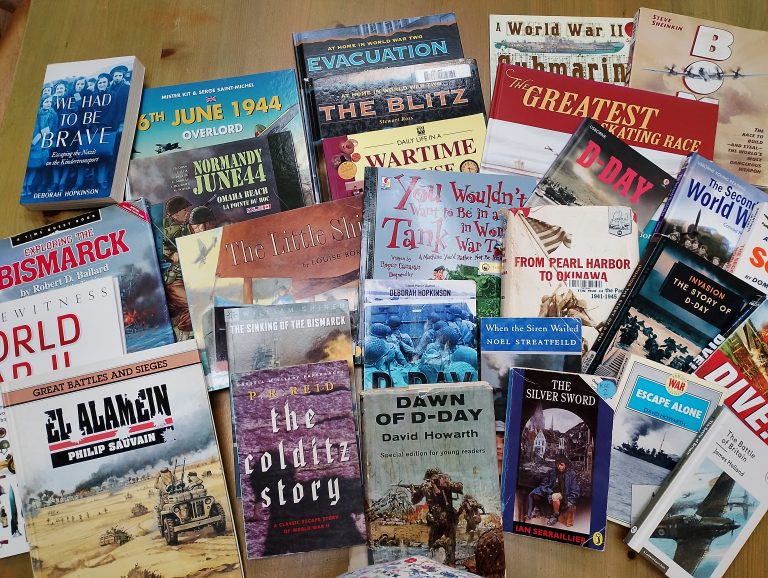
World War II
The Little Ships
Louise Borden
This picture book tells the story of Dunkirk from the perspective of a girl who travelled across with the flotilla of ‘little ships’ to rescue men stranded on the beaches. The illustrations by Michael Foreman are beautiful. Neither the writing nor the illustrations is particularly gory. To give you an idea, I think this is the most explicit line in the book: ‘I couldn’t look for more than a second at a soldier who cried for me to give him water, who had no bandages, just blood all down his front’. A good choice for slightly younger children wanting to understand something about the events of WWII.

A World War II Submarine
Richard Humble and Mark Bergin
This is part of the Spectacular Visual Guides series of information books. There are a couple of pages about the development of submarines, complete with diagrams of various subs. Then follows several pages of diagrams explaining all the details of the WWII submarine, and then a description of various aspects of life on board. The latter part of the book covers the battle of the Atlantic and U-Boat attacks. This is a great choice for children who enjoy understanding the nitty-gritty details about how something works, and are interested in submarines.


Exploring the Bismarck
Robert D. Ballard
A Time Quest book dealing with the search for, and exploration of, the wreck of the Bismarck. As with other Time Quest books, the details of the wreck exploration are interleaved with semi-fictional sections about life on board ship, covering events in the run up to the sinking. This is probably the bulk of the book, and I think is well done. There are lots of photographs and diagrams to aid understanding.
I think this is one of the better books in the series, and it has been greatly loved and re-read in our house. There are some good underwater photographs of the wreck, in which you can clearly see various shell holes. There is also less time spent on the process of submersible exploration than others in the series, which I think is a positive.
Content warning: there are some gory details about the sinking. E.g. there is both a photograph and text description of the recovery of survivors from the water by the British cruiser Dorsetshire. ‘One man whose arms had been blown off was trying to grab a line in his teeth’.


The Sinking of the Bismarck: The Deadly Hunt
William Shirer
I think that this is a republication of a Landmark youth history book. It is one for older children, being mostly text with a few photographs and diagrams (roughly 150 pages). The story is told fairly simply, but it is an exciting and compelling read, and will give the reader a good understanding of the events of this important Atlantic sea battle.

Dive! World War II Stories of Sailors and Submarines in the Pacific
Deborah Hopkinson
A well-thumbed book here! The book is comprised of lots of short stories, arranged chronologically. There are quite a number of black and white photographs, and some short timeline sections for each year of the war. Although this is a longer book (well over 300 pages), I think it is surprisingly easy to read, because the individual stories are short and exciting. You can pick it up and put it down without losing too much of the narrative thread.

From Pearl Harbour to Okinawa: The War in the Pacific 1941-1945
Bruce Bliven Jr.
A book in the Landmark youth history series. It isn’t specifically a naval history book, but the War in the Pacific included a lot of naval battles. This book is one for older children, with roughly 180 pages of fairly dense text, and a few maps. I think that the author, Bruce Bliven, does a good job of succinctly covering the events in this arena of war.
It took me a while to find a copy at a reasonable price, but it is worth looking out for. This, coupled with Dive! (Deborah Hopkinson) are the only children’s books I have been able to find about WWII in the Pacific.