

Using Logic of English to teach a child to read
This post contains affiliate links. As an Amazon Associate, I earn from qualifying purchases.
I have been through the entire Logic of English Foundations course A – D, and in this post I share my perspective on the curriculum. Logic of English is an extremely thorough phonics program, some might say excessively so! It is also a lot of fun, with plenty of active games and activities to mix things up. I think LOE particularly suits children who are perhaps reluctant or might face extra challenges with learning to read. For example, I used it successfully with a child with developmental verbal dyspraxia (called apraxia in the US), and thought it was a good fit because of the strong emphasis on formation of different sounds. I think it could also be really good for an active and energetic child who doesn’t want to stay at a desk for too long.
As I’ve mentioned elsewhere, I think that the best and easiest way to teach a typical child to read is through gradually staged ‘decodable’ readers. However, in order to reach the point of using readers, a child needs to develop their phonological awareness, learn to blend sounds together, and learn to recognise at least some letters. It is at this early stage that I think Logic of English is able to add the most value.
We live in the UK, so we have slightly different pronunciation and vocabulary to the US. I have written a separate post to cover some UK-specific points to note, which you can find here.
I have reviewed each level of LOE Foundations in turn. If you want to skip to a particular part of the post, you can use these links:
- Logic of English Foundations A
- Logic of English Foundations B
- Logic of English Foundations C
- Logic of English Foundations D
- Overall thoughts on LOE Foundations
Logic of English Foundations A

This first level of LOE is the one that I have found most useful, and have returned to several times to teach different children. I had previously used a different resource (How to Teach your Child to Read in 100 Easy Lessons) to teach my eldest child to read, and I found that LOE was hugely better at teaching ‘pre-reading’ phonological awareness skills. That is, it provides lots of practice at blending sounds together to make words, and discriminating the first and last sounds in a word. Many children will need lots of practice at these kinds of activities before they are ready for reading. LOE contains lots of fun activities such as running around the room to find a P-E-N, or colouring the picture of a C-A-T on a worksheet. I would recommend buying the PDF copy of the Student workbook, so that you can print the worksheets multiple times for these activities and enjoy some gentle repetition.

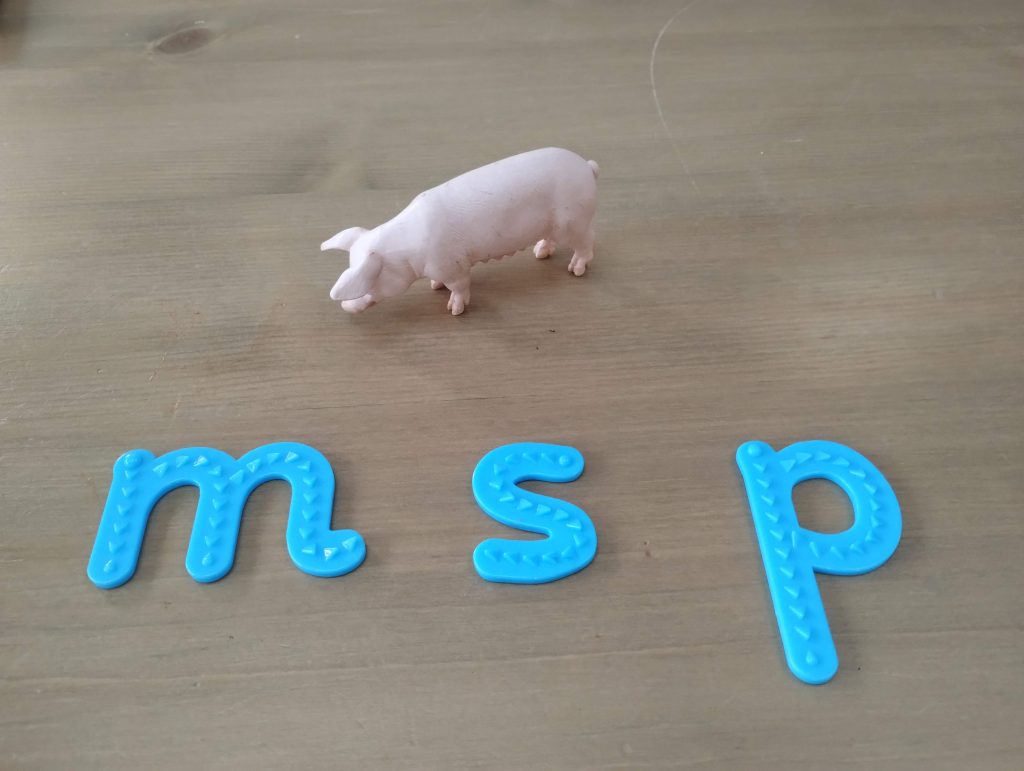
Of course, one can easily do many of these activities at home without a textbook, such as by gathering up some toy animals and asking children to find the one that starts with a D. However, if you have no experience of teaching phonological awareness (which most of us don’t!) then Foundations A provides plenty of hand-holding and fun ideas.
LOE is also excellent for children with speech and language challenges. Right from the beginning there is an emphasis on hearing and discriminating between different sounds. The lessons also help children with forming different sounds with their mouths, and learning about the difference between voiced and unvoiced pairs of sounds (e.g. t and d, c and g). Now for the average child this is probably overkill, and I have skipped over it with some of my children. But for the child with verbal dyspraxia/apraxia or other speech impediment issues, this material is fantastic. It ties in really nicely with the work that you would do in speech therapy on these concepts, and on eliciting different sounds.
One other thing that I really like about Foundations A is the DIY early readers. These are paper books that you put together, and the children stick in the right pictures on the right pages. My children just LOVED these books, I think we made most of them multiple times. The first book literally has a single word on each page, and the books then move on to short phrases. I found that these books filled a real gap where children are beginning to read single words and want to grow in confidence, but would still find whole sentences exhausting. I have found a few similar flip books from RWI (view the ‘blending books’ series on Amazon), but there is something really fun about making your own book. The workbook pages are formatted in US page sizes, so if you are printing yourself on A4, you do need to be a bit careful to make everything line up.


I am not too keen on the order in which the phonograms are introduced. The order is heavily dictated by the handwriting formation, so that a, d, g, o and c are introduced first, with the uncommon phonogram qu being the sixth phonogram introduced! The very fact that these phonograms are similarly formed makes it harder to discriminate visually between them. I prefer the typical UK ordering where s, a, t, n, i, p are the first letters introduced. These are easy to distinguish visually, and they enable a child to form a large number of words and begin blending very quickly.
I prefer to teach my children to read when they are quite young, and so I usually separate the processes of learning to read and learning to write, because the fine motor skills needed for writing come later. Therefore I don’t make that much use of the handwriting portion of these early lessons. I acknowledge that I might be keener on the LOE phonogram ordering if I were doing more work on letter formation at this point.
Logic of English Foundations B

In LOE Foundations B, children move on to learning multi-letter phonograms (e.g. sh, th, er, ee). The book also covers the formation of capital letters, and some of the ‘silent E’ rules. That is, reasons why a word might need to have a silent E at the end.
I make extensive use of decodable phonics readers, so it was during this book that I noticed that my children’s reading ability was beginning to outstrip the level that they should have been at according to LOE Foundations. There were however many features of LOE B that were still useful, particularly for working on speech and language issues. LOE B continues to develop phonemic awareness; there are fun activities covering rhyming words and number of syllables. There is also lots of practice at articulating consonant blends, which was helpful.
I also really liked some of the comprehension activities, such as drawing in the pictures for the captions of a story that you are given. My children really enjoyed that one! There are also some fun riddle-type activities where you guess the answer from reading the clues. As always, the workbook is colourful and varied. I do prefer to purchase the PDF version so that we can reprint if we want to have another go at an activity.
I didn’t enjoy the Foundations B readers as much as our experience of the self-made readers in Foundations A. Firstly, my children had enjoyed those readers so much that they were sad not to get more of them! Secondly, I just wasn’t that riveted by either the plotlines or the illustrations, compared to some of the other readers that we use. I accept that it is quite challenging to write an interesting story in under 100 words with extremely limited word structures available, but it is possible (e.g. Julia Donaldson’s Songbird readers). Some had (mildly!) scary plot elements that my children did not enjoy.


Logic of English Foundations C

In LOE Foundations C, children learn some more unusual phonograms (e.g. eigh, ph, augh) and begin to work on more ‘usage’ rules such capitalisation and using commas in a list. There is an increasing emphasis on broader comprehension skills such as making predictions and inferences, putting events in order, and identifying key words.
I dithered a little over whether to purchase Foundations C, as each book of the course is quite expensive, and we were now significantly outstripping the decoding level of the readers. However, I did decide to go for it, mostly for the comprehension and writing elements of the course, which were areas that I thought would be particularly helpful for a child with language difficulties.


I skipped over some elements of Foundations C, particularly some of the wordier spelling rules, which I just didn’t think were comprehensible or useful to a child with language problems, and didn’t seem necessary for another of my children who is a natural speller. Rules such as ‘O may say /u/ next to W, TH, M, N or V’ are pretty hard to remember, and some of the example words (e.g. from) don’t apply in British English. It’s so much easier to just remember that ‘O can say o, oh, oo and u‘.
(As an aside, I have found Apples and Pears spelling much more effective for teaching spelling to a child with language problems, as it isn’t reliant on them remembering and applying lots of wordy rules!)
One phonics element that I did appreciate in Foundations C was the teaching on ED which can say ed, d, or t. This was a really helpful thing to emphasise, and helped us greatly in learning how to pronounce the many many words with this ending.
The language work on compound words, comparatives, prepositions, riddles and descriptive language was all very helpful to us.
Logic of English Foundations D

LOE Foundations D is rather a different style from the earlier levels. There is more of an emphasis on grammar and spelling, and lots of work on fluency and comprehension. This level includes external readers for the first time. There is still some ongoing phonogram work with the introduction of some unusual phonograms, some of which are often found in words imported from other languages (e.g. the ‘e’ in cafe and latte).
Even more than with Foundations C, I dithered about whether to purchase this level or not. I knew that the reading ‘decoding’ level would be below what we needed, but I was attracted to the external readers, and the accompanying comprehension work which was all neatly organised for me. I also hoped that it would provide a gentle introduction to grammar alongside.
With hindsight, I think it was probably not the best choice for our particular situation. We were not able to get the most benefit from the reading practice, because we had already made that progress using other decodable readers.
I really disliked how LOE Foundations handles spelling. The words are generally selected from the readers, and do not really follow any sort of pattern, but will be a hodgepodge of different spelling rules. I didn’t particularly feel that they were helping either of my children (who have quite different learning styles) to learn to spell. All About Spelling at a fast pace has been a much better fit for one, and Apples and Pears has been really really helpful to the other. I think that we missed nearly a year’s opportunity for progress in spelling by assuming that it was covered by LOE Foundations, when it actually wasn’t really helping.
I did find the grammar content and the few simple grammar rules helpful, but again I feel that we could have progressed at a faster rate with a different resource.
The books and the accompanying comprehension questions and activities were mostly enjoyable, and I appreciated having the scripted questions and gentle pace for my child with language challenges. However, I don’t think that this element of the course was enough in itself to justifying the cost and the time spent on it. We ended up stopping a few lessons before the end and moving on to other things, which is an unusual thing for me to do.


Overall thoughts on LOE Foundations
LOE Foundations is a thorough phonics and learning to read program, with much to recommend it. The speech and language elements in particular will be very helpful to children who have challenges in those areas. The workbooks are colourful and varied, and there are lots of games and opportunities for movement during the lessons.
My favourite book in the series is Foundations A, as I think the phonemic awareness activities and games are really helpful for pre-readers. They are lots of fun, and a low-pressure way to begin building the skills needed to reading. I also love the DIY word and phrase readers, which I think really fill a gap, and build confidence for children just beginning to blend. I will continue to use this resource with my younger children, though not every element. I tend to leave handwriting for later.
As the series progresses, I feel that for our family, the usefulness declines relative to the time and cost. Once they can decode and blend one-letter phonograms, I find that my children make good progress at learning to read by just using graded readers and a whiteboard with foam letters for practice. I don’t really like the way that LOE teaches spelling (haphazard word lists, and a lot of rules). I do however appreciate some of the colourful and fun language and comprehension activities that are included in the series, and feel that those have been very helpful for one of my children who has language challenges.


