Bedrock vocabulary: a parent’s review
This article is a review of the online Bedrock vocabulary program, which you can find here. I believe it is widely used in British schools, but my review is written from the perspective of a parent purchasing a subscription to use at home, to help a child who needs more support with language acquisition.
- Vocabulary learning and DLD
- What is Bedrock vocabulary and how does it work?
- What about Bedrock grammar?
- Final thoughts on Bedrock vocabulary
Vocabulary learning and Developmental Language Disorder
I took out a subscription to Bedrock to support one of my children who has Developmental Language Disorder, or DLD for short. This is a surprisingly common condition in which children have more than usual difficulty in understanding and using language. It is very under-researched (compared to say, dyslexia), and one of the frustrations as a parent is that the evidence-base for what actually helps is very limited.
The existing research does suggest that explicit vocabulary instruction is helpful to students with DLD. That is, where many children acquire vocabulary implicitly, just through hearing it in everyday life, books and the classroom, children with DLD benefit from clear and explicit instruction about how to use a particular word. It is helpful if that knowledge can be tied in to their existing word knowledge (e.g. synonyms, antonyms, number of syllables, category) which helps with retention and later retrieval.
Speech therapy, reading practice and other language work can be very parent-intensive, so I started looking around for an online learning option that my child could operate by themselves to get some extra practice, ideally something fun and easy to understand.
What is Bedrock vocabulary and how does it work?
Bedrock is an online subscription-based program. The student completes a short initial assessment which places them into an initial ‘block’ of lessons, ranging from Block 3 to Block 12, based on their estimated current vocabulary level. So far as I can tell, the blocks correspond to typical expectations for English school years 3 to 12, where Block 3 would be 7-8 years old, and Block 12 would be 16-17 years old.
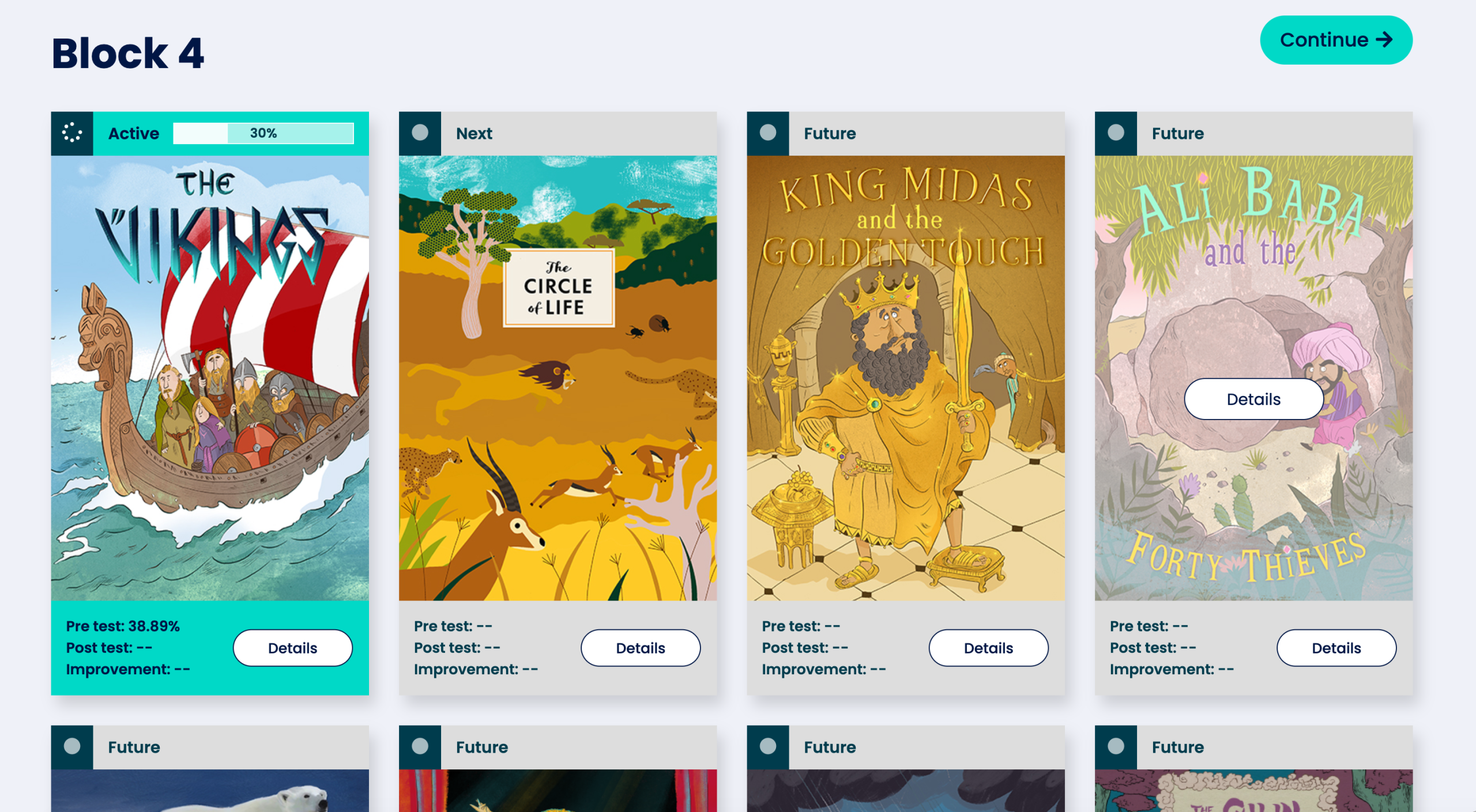
Each Block includes 10 topical units.
- A typical Block 3 unit is titled Galileo, and covers 18 new words such as agree, instrument, telescope and universe.
- A typical Block 7 unit is titled A Journey to the Sahara and covers 30 new words such as accommodate, arid, conspicuous, deluge and terrain.
- A typical Block 12 unit is titled The Life of Mary Seacole and covers 18 new words such as inimical, proclivity, contingent, maelstrom and linchpin. Looking at this level I felt there was a curious mixture of words which are quite common (contingent, convalesce) and words I have never used in English ( milieu, nonpareil).
The only way I have found as a parent to look at the vocabulary lists for each Block is the spreadsheet shown in this instructional Youtube video. If you start watching at about the 3.30 mark you can see the instructor scroll through the vocabulary lists. I found this extremely helpful when gauging whether my child was ready to begin the program.
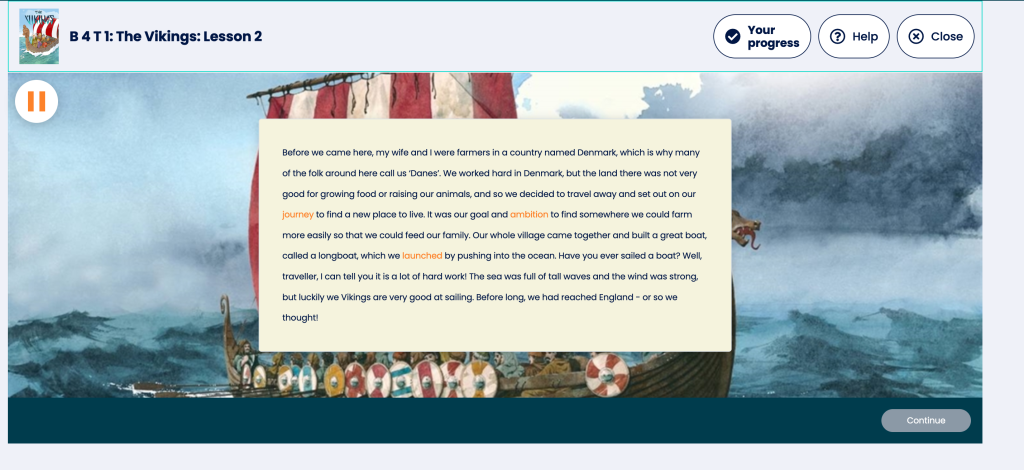
Each topical unit includes an opening quiz, six lessons, and a closing quiz to measure progress. Students can complete up to two lessons each day. The lessons are a mix of different activities. They begin with a short passage from the overall story (e.g. a simple biography of Galileo), which includes the target words for that lesson in context. Children can then click on the words to see a definition.
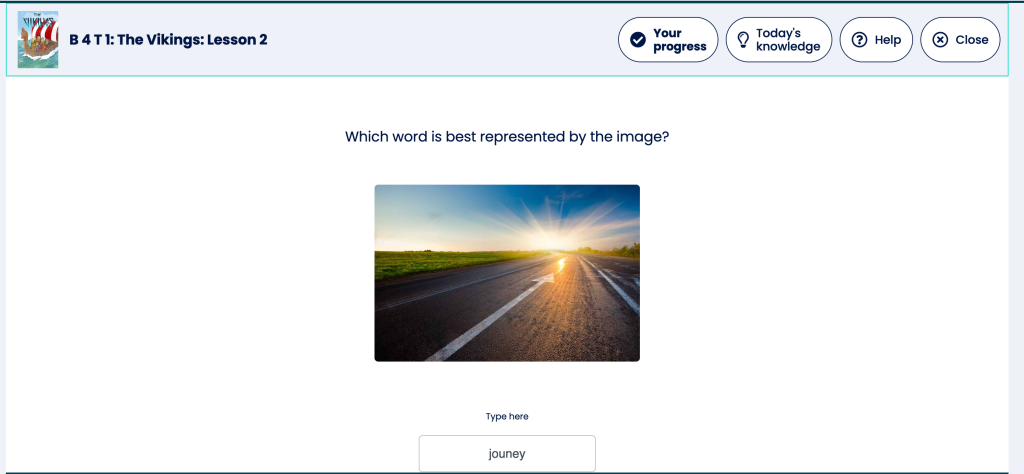
Following the reading passage, there are a few comprehension questions, and then various activities based on the target words. These are generally straightforward and helpful. There can be a bit of an issue with spelling. In the screenshot below, the student has typed the word journey incorrectly, and will be marked wrong. I would rather the software picked up that this was a spelling error rather than an understanding error, and was able to explain this to the student.
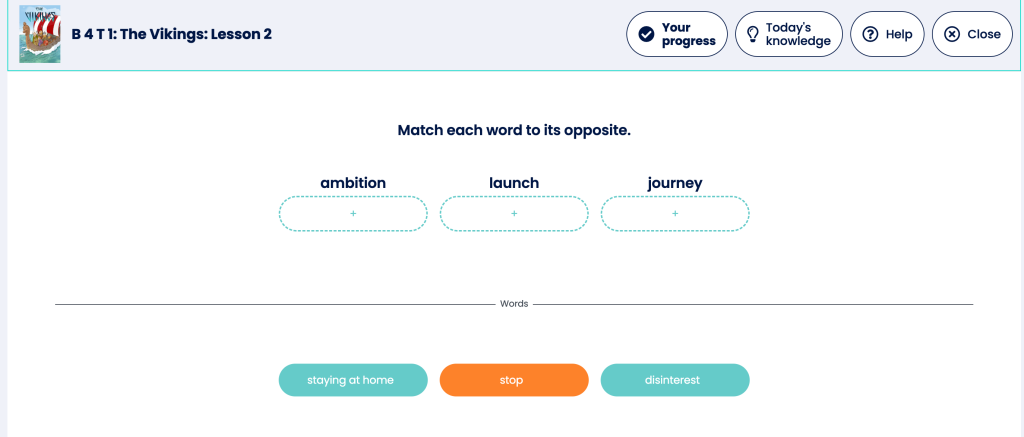
The activities vary from lesson to lesson, but there are a couple of activities that my student found particularly challenging. In particular, there is an activity where five words are hidden under playing cards, and revealed for a few seconds. The student needs to match a pair with a similar meaning, and a pair with opposite meaning, and ignore the fifth word. This activity was already challenging enough for my child with DLD without the added time and memory component of having the words hidden from view. DLD is often associated with poor working memory, and there is not much evidence at the moment for anything that can help with this.
Another frustrating activity is the one where the student is asked to choose 3 out of 6 words that mean something similar to ‘doubt’. If the student gets 2 correct and one wrong, they is just told that the answer is wrong. My student then swaps things around and gets 2 correct and one wrong again, but different ones! I think my student would learn more from having the correct answers turn green, and trying to find the extra matching word.
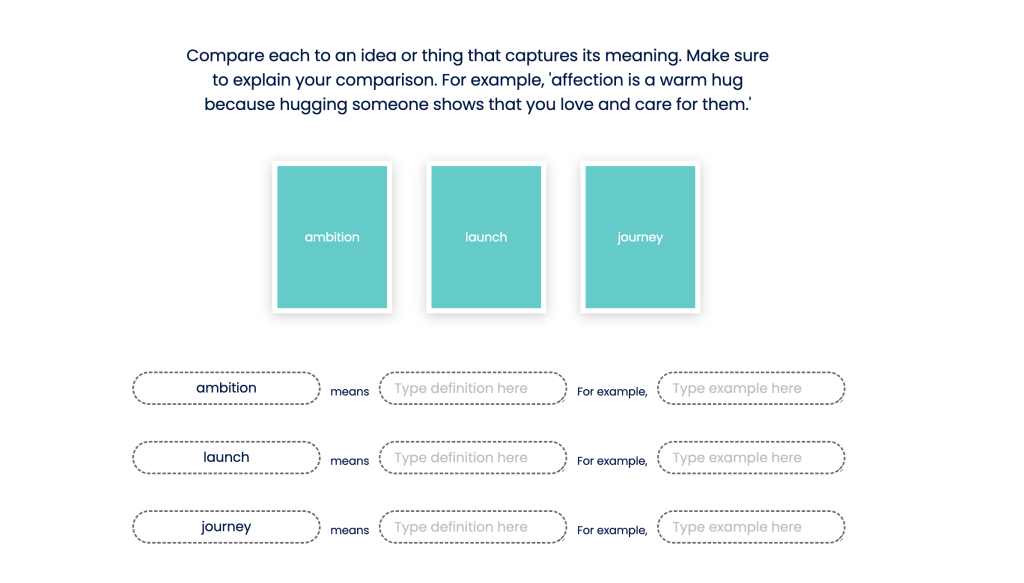
The final activity will typically involve the student writing their own definitions of the target words, which are saved to their ‘knowledge organiser’. This requires a decent level of typing skill, and a higher level of understanding than the other activities. It is often beyond my particular student at the present time, and they have learned to ‘game’ the system by typing any old letter in the box.
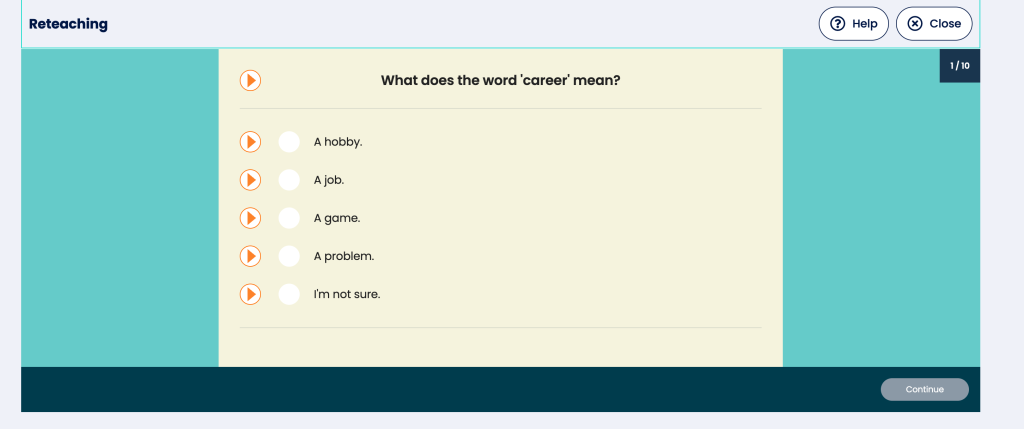
There are also short ‘recap’ activities at the start or end of each lesson to go over vocabulary from previous units.
Is Bedrock vocabulary effective for a student with DLD?
My student began Bedrock right at the beginning of Block 3, and completed the whole of Block 3 over the course of about four months. They enjoyed the program and were happy to work on it several times a week. This, I feel, is significant in itself! There is no point in having an independent program unless the student is motivated to work on it.
Bedrock conducts a pre-quiz and post-quiz for each unit, so that the instructor can gauge student progress. My student with DLD had an average pre-quiz score of 44.9%, rising to an average post-quiz score of 60.1%. This was an encouraging improvement, but I still didn’t feel that they were ready to move on to Block 4; after all, they were still working on learning 40% of the vocabulary from Block 3!
The Bedrock support team were very responsive, but explained that there was no way for me to reset the program and have the student complete Block 3 again. However, I was able to work around this by cancelling the subscription and setting up a new account a few months later with a slightly different student name, starting again from the beginning. This time my student had a pre-quiz average score of 59.5% and a post-quiz average score of 73.4%. Not only had my student retained the vocabulary learned over an extended period, but they were able to make further progress by going over the units again.
I do think that there was probably also an element of my student improving their skills at completing comprehension style exercises, e.g. close reading of the question, understanding what you are supposed to be looking for. I think this is a very good thing, it is an important literacy skill which is challenging for children with DLD.
Overall, I was surprised and delighted by how much my student learned and retained, and plan to continue with the program. It is likely that we will need to continue to ‘reset’ the program with a new account in order to redo each Block, which is a bit frustrating, but manageable.
What about Bedrock grammar?
Bedrock also has a grammar program operating within the same subscription. We played around with this a bit, but ultimately found that it was too challenging for my student who is at the younger end of the intended age range. This was a bit sad because there were a number of grammar activities which were age-appropriate and would have been helpful to my student (e.g. identifying nouns and verbs).
Final thoughts on Bedrock vocabulary
Overall, I would recommend Bedrock vocabulary as one of the few ‘pre-prepared’ offerings I have come across which I think could be very helpful to students with DLD. There are so many different facets of language learning to work on when helping a student with DLD, so it is wonderful to be able to find something more independent to extend their knowledge, freeing up space for me as a parent to focus on other areas such as grammar and syntax.
I did experience some frustrations with the program. In particular, I would love more flexibility as the instructor to modify the program to suit my student. It would be very helpful to be able to reset each Block and have my student run through the block a second time. I would also love to be able to create some bespoke modules to work on e.g. science vocabulary as a support to my child’s wider learning. I believe this may be an option in the schools program, but it is not something I am able to do as a parent.
I also feel that some of the activities could be improved to give better feedback to students (e.g. distinction between a meaning error and a spelling error). Several activities had instructions which were just plain confusing for a child who already has language difficulties.
Overall however, I’m delighted to have found a resource which my child enjoys, and which is helping them to increase their vocabulary and confidence with the English language.